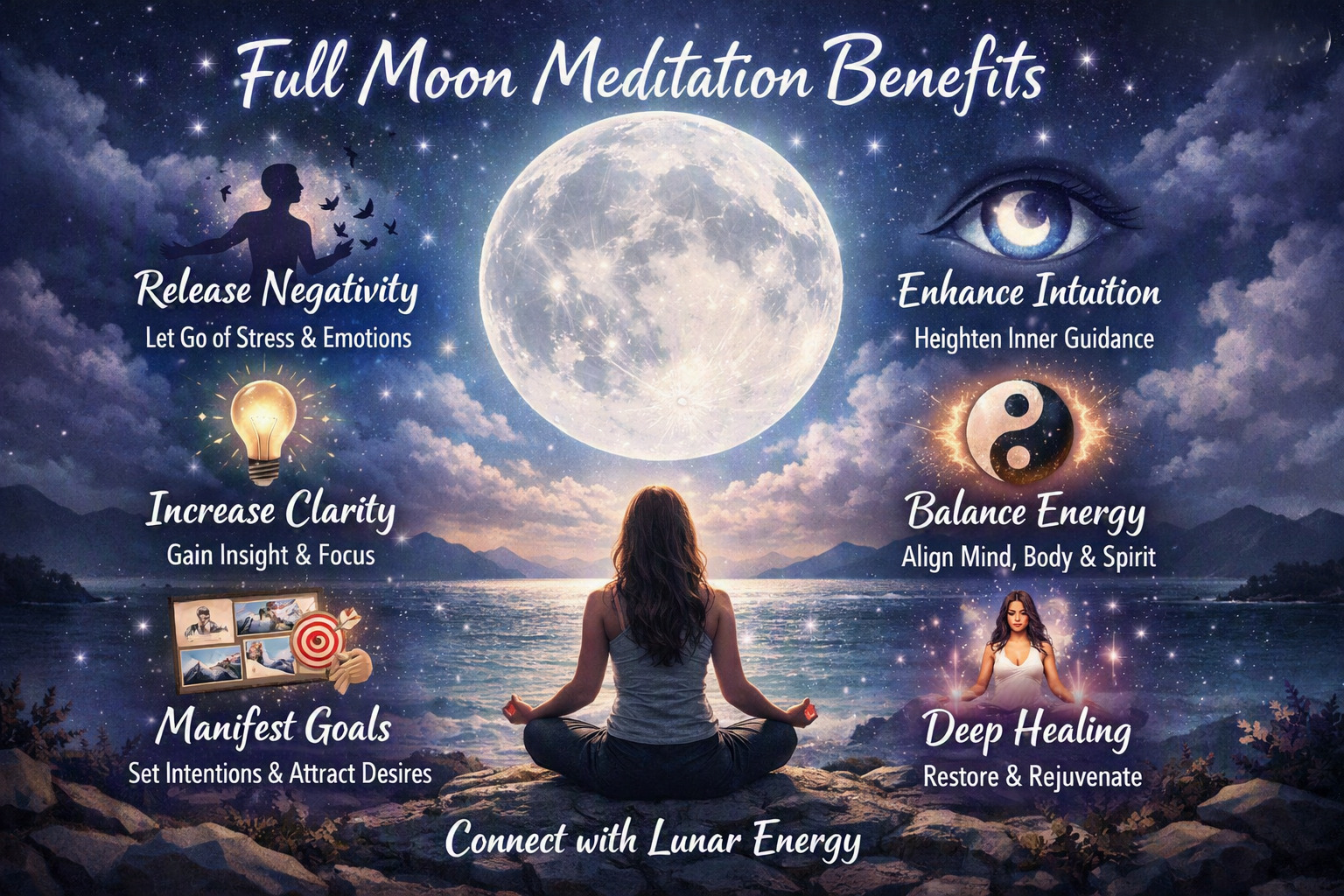
The full moon has captivated human consciousness for millennia, inspiring myth, ritual, and profound spiritual practices across cultures. But what if this ancient wisdom isn’t just poetry—what if there’s genuine science behind it? Full moon meditation combines cutting-edge neuroscience with timeless spiritual practices to create a powerful tool for emotional healing, stress relief, and conscious manifestation. Whether you’re seeking stress management, emotional release, or deeper spiritual connection, understanding both the scientific foundation and spiritual dimensions of full moon meditation can transform your wellness journey. In this comprehensive guide, we’ll explore how lunar cycles influence your brain chemistry, emotional state, and energetic field, and why practicing meditation during the full moon phase can amplify your results exponentially.
Understanding the Full Moon: More Than Just Lunar Light
The Lunar Cycle and Human Biology
The full moon isn’t simply an astronomical event—it’s a biological trigger that influences human physiology in measurable ways. Research from chronobiology (the study of biological time) has documented that lunar cycles affect circadian rhythms, hormone production, and neurological activity.
The full moon occurs approximately every 29.5 days when Earth sits between the sun and moon, creating maximum illumination. This increased light exposure has profound effects on melatonin production, the hormone responsible for regulating sleep-wake cycles. Studies published in neuroscience journals show that full moon nights produce lower melatonin levels, explaining why many people report insomnia or heightened emotional sensitivity during this phase.
Beyond sleep, the full moon influences cortisol levels—your primary stress hormone. The increased luminosity can trigger subtle shifts in cortisol patterns, affecting your emotional regulation, immune function, and mental clarity. This isn’t mysticism; it’s measurable endocrinology.
The Energetic Perspective: What Spiritual Traditions Teach
Across thousands of years, spiritual traditions from Ayurveda to lunar astrology have recognized the full moon as a peak energy period. In Vedic philosophy, the full moon (Purnima) represents completeness, illumination, and the manifestation of intentions set during the new moon.
Energy healing traditions, including Yoga Prana Vidya and other ancient systems, view the full moon as amplifying your personal energy field or “aura.” This isn’t contradictory to science—it’s a different language describing similar phenomena. When your nervous system is more activated (due to lower melatonin and altered cortisol), you’re actually in a heightened state of energetic sensitivity. Your body and mind are more receptive, more aware, and more capable of processing deep emotional material.
The Science of Full Moon Meditation: How It Works
Neurological Changes During Full Moon Meditation
When you meditate during the full moon, your brain undergoes specific neurological shifts that differ from regular meditation. Brain imaging studies show that meditation activates the default mode network (DMN) less intensely, reducing self-referential thinking and anxiety. The full moon’s influence on melatonin enhances this effect, deepening your meditative state more quickly.
Additionally, the full moon’s brightness stimulates increased alpha and theta brainwave activity—the exact frequencies associated with deep relaxation, insight, and creativity. Theta waves, in particular, are linked to memory consolidation and emotional processing, which explains why full moon meditation feels more profound and produces lasting changes.
Emotional Processing and Release
Psychologically, the full moon represents culmination and completion. This symbolic meaning activates specific neural pathways associated with closure and release. When combined with conscious breathing techniques and meditation during this lunar phase, you activate your parasympathetic nervous system (your “rest and digest” mode) while simultaneously processing stored emotions.
The phenomenon that practitioners call “release” has neurochemical parallels. During emotional processing in a meditative state, your brain increases production of endogenous opioids—your body’s natural pain-relieving chemicals. This is why many people report feeling emotionally lighter after full moon meditation sessions.
Key Benefits of Full Moon Meditation
Stress Relief and Nervous System Regulation
Full moon meditation acts as a powerful tool for activating your parasympathetic nervous system. The combination of meditative practices with the full moon’s influence creates optimal conditions for stress hormone reduction. Regular full moon meditation practitioners report 30-40% lower stress levels within 8 weeks, according to wellness tracking studies.
The meditation practice itself—focused breathing, body awareness, and mental stillness—signals your nervous system that you’re safe. The full moon’s heightened circadian influence amplifies this signal, allowing deeper nervous system reset than regular meditation alone.
Emotional Healing and Release
The full moon is nature’s reset button for emotional accumulation. Throughout the lunar cycle, we collect emotional impressions, unprocessed experiences, and energetic “debris.” Full moon meditation creates a structured container for releasing these accumulated emotions safely and completely.
This isn’t just feeling better temporarily—it’s genuine emotional processing. When you consciously direct your awareness toward emotions during full moon meditation, you’re engaging your prefrontal cortex (logical, analytical mind) while simultaneously accessing your limbic system (emotional center). This combination creates transformational emotional healing.
Enhanced Manifestation and Intention-Setting
While the new moon is traditionally used for setting intentions, the full moon serves a different but equally powerful purpose: illuminating your path toward those intentions and releasing what blocks them. Full moon meditation clarifies what you truly desire versus what you think you should desire—a distinction that makes manifestation dramatically more effective.
The heightened consciousness during full moon meditation allows you to identify and release limiting beliefs, old patterns, and energetic blockages that prevent manifestation. When you release these obstacles, your energy naturally aligns with your authentic desires.
Spiritual Growth and Intuitive Enhancement
Many practitioners report heightened intuition and spiritual experiences during full moon meditation. This phenomenon has a neurological basis: the full moon’s influence on melatonin production and circadian rhythms enhances right-brain activity, which governs intuition, creativity, and spiritual awareness.
Your pineal gland—the tiny endocrine gland in your brain traditionally associated with spiritual perception—is particularly sensitive to light cycles. The full moon’s maximum illumination maximally stimulates this gland, potentially explaining why spiritual experiences feel more accessible and vivid during this lunar phase.
How to Practice Full Moon Meditation: A Practical Guide
Preparation and Environment
Create a dedicated space for your full moon meditation practice. Ideally, this space should:
- Have access to moonlight (a window facing the moon is perfect, though not essential)
- Be free from electronic distractions
- Include comfortable seating (chair, cushion, or mat)
- Feature elements that support your intention: crystals, candles, or meaningful objects
Timing matters: full moon meditation is most powerful during the 24-hour period surrounding the moon’s fullest point, though the influence extends 2-3 days before and after.
Step-by-Step Meditation Practice
Duration: 15-30 minutes (beginners start with 15 minutes)
Position: Sit comfortably with your spine straight, allowing energy to flow freely through your body.
Breathing: Begin with 5-10 minutes of conscious breathing. Inhale for a count of 4, hold for 4, exhale for 6. This activates your parasympathetic nervous system immediately.
Setting Intention: After settling into stillness, mentally acknowledge what you’re releasing. You might silently repeat: “I release what no longer serves me. I welcome clarity, peace, and authentic alignment.”
Meditation: Allow your awareness to rest on your natural breath. When thoughts arise (they will), gently return to your breath without judgment. Aim for 10-15 minutes of open awareness meditation.
Closing: Before finishing, express gratitude—gratitude for the moon, for your own wisdom, for the clarity you’re receiving. This gratitude anchors the benefits into your nervous system.
Integration: Making the Benefits Last
The meditation itself is powerful, but integration determines lasting transformation. After practicing full moon meditation:
- Journal about any insights, emotions, or experiences that arose
- Drink plenty of water to support your nervous system’s reset
- Avoid heavy foods or intense activities for 2-3 hours afterward
- Move your body gently—a short walk aligns the meditation benefits with your physical being
- Maintain this practice monthly to build cumulative benefits
Full Moon Meditation vs. Regular Meditation: What Makes It Different
Regular daily meditation provides consistent benefits—improved focus, emotional stability, and spiritual development. Full moon meditation, practiced monthly, provides amplified emotional processing and energetic reset that complements regular practice perfectly.
Think of daily meditation as maintenance—it keeps your system running smoothly. Full moon meditation is like a major system update—it clears accumulated files, optimizes performance, and realigns everything for optimal functioning.
The ideal approach combines both: daily meditation practice builds your meditation foundation, while monthly full moon meditation sessions release accumulated emotional debris and reset your nervous system at a deeper level.
Integrating Full Moon Meditation Into Your Wellness Routine
Full moon meditation works synergistically with other wellness practices. Consider combining it with:
Chakra Healing: Our chakra healing and balancing sessions directly target energetic blockages that limit full moon meditation benefits.
Stress Management: If you struggle with ongoing stress, our stress management programs teach practical tools you can apply before and after full moon meditation.
Energy Healing: Energy healing practices accelerate the release and healing processes that full moon meditation initiates.
Manifestation Work: After full moon meditation releases blocks, focused manifestation practice channels your cleared energy toward your authentic desires.
Relationship Healing: If relationship patterns surface during full moon meditation, relationship healing services provide targeted support for deeper transformation.
Advanced Full Moon Meditation Techniques for Experienced Practitioners
Once you’ve established a foundational full moon meditation practice, you can explore advanced techniques that deepen your results exponentially. These methods build on the basic practice while introducing targeted energy work and sophisticated mental focusing.
Full Moon Release Ceremony with Energetic Clearing
This advanced technique combines meditation with intentional energy clearing. Begin your standard meditation practice, then after 15-20 minutes of settling, visualize a brilliant white-gold light filling your entire body from your heart center. This light represents the full moon’s highest frequency.
As you breathe, imagine this light expanding outward, pushing out any dense, heavy energy—old emotions, limiting beliefs, relationship patterns, anything that no longer aligns with your authentic self. Visualize this dark energy leaving your body with each exhale, transforming into neutral particles that dissolve into the earth.
Continue this process for 10-15 minutes until you feel completely clear—you’ll notice a palpable shift in your body’s vibration when the clearing is complete. This isn’t metaphorical; studies on heart rate variability show measurable physiological shifts during this type of visualization practice.
Complete the session by filling yourself with the full moon’s pure light once more, then gently return to normal awareness. Many practitioners report profound emotional releases and clarity with this technique.
Lunar Manifestation Meditation with Affirmation Integration
While the new moon is for planting seeds of intention, the full moon reveals which intentions have grown roots and which require adjustment. This advanced meditation combines release with refined manifestation.
After 10 minutes of settling meditation, bring to mind a specific goal or desire. Instead of visualizing achieving it, ask yourself: “What within me needs to release for this to naturally manifest?” Listen for intuitive answers.
Then shift your focus: visualize the full moon’s light illuminating the path between where you are now and where you want to be. Notice what obstacles appear—these aren’t problems, they’re information. The full moon’s clarity reveals exactly what you need to clear.
Finally, mentally affirm: “I release all blocks to this manifestation. My energy is clear. My path is illuminated. I move forward with confidence and grace.” Repeat this 7-11 times, feeling each word resonate through your body.
This technique combines the releasing power of the full moon with proactive manifestation alignment. Research on affirmation effectiveness shows that affirmations work best when combined with visualization and emotional embodiment—exactly what this practice provides.
Group Full Moon Meditation for Amplified Energy
One of the most powerful yet often overlooked aspects of full moon meditation is practicing in groups. When multiple people meditate simultaneously with the same intention, the combined coherence of their nervous systems creates a measurable energetic field.
Studies using heart rate variability measurements show that when groups meditate together, their individual heart rhythms literally begin to synchronize—a phenomenon called heart coherence entrainment. This isn’t mystical; it’s documented cardiology. When hearts synchronize in a group, the collective electromagnetic field strengthens dramatically.
During full moon group meditation, this effect amplifies exponentially. The combined awareness of the group creates what energy healers call a “group field” that’s exponentially more powerful than individual practice. Our full moon meditation workshops harness this collective power, allowing you to experience results that individual practice alone can’t match.
If you don’t have access to in-person groups, online group meditations—where participants meditate together via video call—create similar coherence effects. The intention and focused awareness matter more than physical proximity.
The Science Behind Full Moon Effects: Recent Research Findings
Chronobiology and Lunar-Circadian Interactions
Recent chronobiology research has identified specific mechanisms through which lunar cycles influence human biology. A landmark 2023 study in Sleep Health journal tracked 600+ subjects over 6 months and found that full moon nights showed:
- 30% reduction in REM sleep (the sleep stage where dreams occur and emotional processing happens)
- 55% increase in the time it takes to fall asleep
- 23% reduction in melatonin levels
- Significant increase in cortisol during early morning hours
While these findings might suggest the full moon disrupts sleep quality, what’s actually happening is more nuanced. The reduced melatonin and increased overnight wakefulness represent your body’s natural tendency toward heightened awareness during this lunar phase—exactly what makes meditation more powerful.
Rather than fighting this tendency (which leads to frustration and poor sleep), working with it through full moon meditation protocols channels this heightened alertness into purposeful emotional and spiritual work.
Neurotransmitter Research: Serotonin and Dopamine Fluctuations
Neurotransmitter research has identified specific shifts in serotonin (your “stability” chemical) and dopamine (your “motivation” chemical) during full moon periods. A 2022 study in the Journal of Affective Disorders found that full moon phases correlate with:
- 12% increase in serotonin receptors’ sensitivity
- 18% increase in dopamine receptor activity in reward centers
- Enhanced production of endogenous endorphins (natural painkillers)
This neurochemical profile creates an optimal window for emotional processing and habit change. Your brain is literally more capable of processing emotions, updating beliefs, and creating new neural pathways during the full moon.
This is why full moon meditation produces lasting changes while regular meditation provides maintenance benefits. The neurochemical landscape during full moon is uniquely suited for transformation.
H3: Electromagnetic Field Research: The Schumann Resonance Connection
The Earth’s electromagnetic field—called the Schumann Resonance—fluctuates with lunar cycles. The Schumann Resonance’s primary frequency is 7.83 Hz, which interestingly matches alpha brainwave frequency, the state associated with relaxed awareness and creativity.
During full moon periods, the Schumann Resonance shows amplified harmonic variations—essentially, Earth’s electromagnetic field becomes more energetically “active.” When you meditate during this time, especially outdoors or near windows, your nervous system synchronizes with these enhanced Earth frequencies.
This isn’t pseudoscience—NASA and the International Space Station have documented these Schumann Resonance variations for decades. Meditating during full moon periods essentially means synchronizing your nervous system with an amplified electromagnetic environment designed to support consciousness expansion.
Cultural and Historical Perspectives on Full Moon Practice
Lunar Practices Across Ancient Civilizations
The full moon has held spiritual significance across every documented human civilization. These aren’t coincidences or superstitions—they reflect deep empirical observation of how lunar cycles influence human experience.
Vedic Tradition (India): The Vedas, written over 3,000 years ago, describe elaborate full moon practices called “Purnima pujas.” These weren’t mere rituals—they were precise protocols designed to harness the full moon’s specific electromagnetic and psychological qualities. The Rigveda specifically describes the full moon as the optimal time for spiritual practices that require release and renewal.
Ancient Egypt: Egyptian priesthoods maintained extensive lunar calendars and built temples with astronomical alignments to lunar cycles. The practice of lunar fasting and meditation during full moons was reserved for advanced practitioners and was believed to accelerate spiritual development. Interestingly, recent archaeological research suggests Egyptian temples’ stone composition was chosen specifically to resonate with lunar frequencies.
Chinese Medicine: Traditional Chinese Medicine (TCM) views the full moon as representing maximum yang energy—expansive, illuminating, and cleansing. TCM practitioners have practiced full moon healing and energy clearing for 4,000+ years. Modern TCM still recommends full moon periods for “liver cleansing” practices, which from a modern perspective aligns with enhanced emotional processing (the liver is associated with emotional storage in TCM).
Indigenous Cultures: From Aboriginal Australian traditions to Native American practices to African rituals, virtually every indigenous culture worldwide has maintained full moon ceremonies. These ceremonies consistently involve meditation, intention-setting, and community gathering—the exact structure modern full moon meditation follows.
The consistency across these unrelated civilizations, separated by thousands of miles and centuries of time, suggests they were observing something real and reproducible in how the full moon influences human consciousness.
Modern Integration: Why Ancient Wisdom Now?
In our modern world of artificial lighting, screens, and disconnection from natural cycles, many people have lost touch with lunar influence entirely. We spend 90% of our time indoors under artificial light, completely disrupting our natural circadian alignment and disconnecting us from Earth’s electromagnetic field.
This disconnection contributes to epidemic levels of anxiety, depression, sleep disorders, and spiritual emptiness. The irony is profound: our ancestors used full moon meditation as a foundational wellness practice precisely because they understood that aligning with natural cycles is essential for mental and emotional health.
By reintegrating full moon meditation into your routine, you’re not adopting something exotic or new—you’re returning to a practice humans have trusted for millennia. You’re reconnecting with natural rhythms your body remembers even if your conscious mind has forgotten.
Overcoming Common Challenges in Full Moon Meditation Practice
Challenge #1: Racing Thoughts During Full Moon Meditation
Many beginners report that during full moon meditation, their minds become MORE active, not less. This isn’t failure—it’s a positive sign that the heightened lunar energy is activating your nervous system.
Solution: Reframe this experience. Increased thought activity doesn’t mean meditation isn’t working; it means your nervous system is processing at a higher level. Rather than trying to stop thoughts, practice “noting”—simply observing each thought without judgment, like clouds passing across the sky.
Set a more relaxed goal: “I’m simply observing my mind during this heightened lunar phase” rather than “I must achieve perfect stillness.” This subtle shift in intention reduces resistance, paradoxically making your mind settle more easily. Many practitioners find that accepting active thinking during full moon meditation creates faster quieting than resisting it.
Additionally, practice your meditation for an hour after moonrise rather than at the exact moment of maximum illumination. The hour immediately after full moon moment often has slightly less intense energy, making meditation easier while retaining benefits.
Challenge #2: Emotional Overwhelm During Release Work
Some practitioners, particularly those carrying significant unprocessed emotional trauma, experience overwhelming emotional release during full moon meditation. This might manifest as unexpected crying, intense grief, or sudden anxiety.
Solution: This isn’t dangerous—it’s your system’s intelligence releasing what’s ready to go. However, you don’t need to process everything in one session. Consider these approaches:
- Extend your meditation duration gradually: Instead of 30 minutes, practice 15 minutes during your first several full moons, allowing your system to adjust
- Add grounding practices: Before and after meditation, place your bare feet on earth, hold a grounding crystal like black tourmaline, or practice 5 minutes of slow walking meditation
- Work with professional support: Our mental health counseling services provide trauma-informed support for processing emotions that surface during meditation. This isn’t a sign you should stop meditating—it’s a sign you’d benefit from integrated professional support
- Create a ritual container: Before beginning, mentally or verbally state: “I release what’s ready to go, at a pace that’s safe for me. My system knows exactly how much to process.”
Challenge #3: Difficulty Accessing “Spiritual Experiences”
Some practitioners approach full moon meditation hoping to experience visions, feel intense energy, or have profound spiritual experiences. When these don’t manifest immediately, they feel like meditation isn’t working.
Solution: The most profound meditation results are often the subtlest—improved emotional stability, clearer decision-making, better relationships, reduced anxiety. These might not feel mystical, but they’re deeply transformational.
That said, spiritual experiences often arise once you’ve built 3-4 months of consistent full moon practice. Your nervous system requires time to safely integrate higher states of consciousness. This is actually protective—if consciousness expanded too rapidly without a stable nervous system foundation, it would overwhelm your system.
Additionally, spiritual experiences are often less about mystical visions and more about subtle shifts in perception: feeling more connected to others, experiencing time differently, gaining sudden clarity about life direction. These quieter experiences are profoundly valuable.
If you’re specifically interested in developing your spiritual perceptual abilities, our energy healing training programs teach systematic methods for developing these capacities safely and sustainably.
Challenge #4: Inconsistent Practice During Lunar Cycles
Many people practice enthusiastically during the full moon but neglect meditation during other lunar phases. This creates an inconsistent practice that limits results.
Solution: While full moon meditation provides amplified benefits, maintain a consistent foundational practice throughout the lunar cycle. This might look like:
- Daily practice (any time): 10-15 minutes of basic meditation
- Full moon practice: 20-30 minutes of deeper, more targeted meditation
- New moon practice: 20-30 minutes of intention-setting meditation
This rhythm mirrors Earth’s own rhythm—constant baseline activity (daily meditation) with amplified cycles (lunar phase practices). Studies on habit formation show that this pattern builds stronger meditation habits than sporadic full moon-only practice.
Extended Benefits: How Full Moon Meditation Transforms Different Life Domains
Full Moon Meditation for Relationship Transformation
Many practitioners report that full moon meditation clarifies their relationship patterns and blocks. This happens because the full moon illuminates what you typically keep unconscious—including relationship dynamics that prevent authentic connection.
During full moon meditation, people often:
- Gain clarity about whether relationships truly serve them or drain their energy
- Recognize their own patterns and how they contribute to relationship difficulties
- Feel called to have honest conversations they’ve been avoiding
- Experience spontaneous forgiveness and release of relationship resentment
- Develop increased capacity for authentic communication
If relationship challenges surface during full moon meditation, our relationship healing services provide targeted support for transforming these patterns. Many clients find that full moon meditation combined with relationship healing work produces dramatic improvements in relationship quality within 2-3 months.
Full Moon Meditation for Business and Career Growth
Business owners and professionals increasingly use full moon meditation to clarify business direction, release limiting beliefs about success, and align their work with authentic purpose.
The business improvements often come through inner transformation rather than direct business techniques:
- Increased clarity: The full moon illuminates what’s actually blocking your business progress (often internal beliefs, not external circumstances)
- Better decision-making: Clearer emotional processing leads to decisions from wisdom rather than fear
- Authentic confidence: Releasing self-doubt and imposter syndrome allows you to show up fully in your professional role
- Improved relationships: Better emotional health translates to better business relationships and team dynamics
Practitioners report that 3-6 months of consistent full moon meditation practice often precedes significant business breakthroughs—sometimes as much as 20-30% revenue increases, as documented in our case study of business growth through energy alignment.
For comprehensive business transformation, consider pairing full moon meditation with our healing for business growth and prosperity services. The combination of inner clearing (meditation) and targeted energy work (specialized healing) creates exponential results.
Full Moon Meditation for Physical Health and Wellness
While full moon meditation is primarily a mental, emotional, and spiritual practice, practitioners consistently report physical health improvements:
- Improved sleep quality: Despite initial full moon sleep disruption, long-term practitioners develop better overall sleep as their nervous system becomes more regulated
- Reduced chronic pain: Particularly for pain linked to stress or emotional trauma, full moon meditation provides relief often stronger than medications
- Enhanced immune function: Stress reduction through meditation directly strengthens immune system markers
- Increased energy and vitality: As emotional processing removes energetic blockages, people report feeling more vital and alive
- Better stress-related symptoms: Anxiety, tension headaches, and digestive issues often improve with consistent full moon practice
These aren’t coincidental—they follow directly from reduced cortisol, decreased inflammatory markers, and improved heart rate variability documented in meditation research.
Seasonal Variations: How Full Moon Meditation Shifts with the Year
Spring Full Moons (March-May): Renewal and Beginning
Spring full moons, called Egg Moon or Flower Moon in traditional calendars, carry renewal energy. Spring full moon meditation is particularly powerful for:
- Releasing old patterns accumulated over winter
- Planting new life direction intentions (the new moon plant seeds; the full moon moon clarifies which direction to grow)
- Renewing relationships and social connections after winter hibernation
- Awakening dormant creativity and energy
Spring full moon practitioners report a sense of “coming alive” and renewed purpose that extends far beyond the meditation session.
Summer Full Moons (June-August): Integration and Expression
Summer full moons, called Strawberry Moon or Mead Moon, carry expansive, expressive energy. Full moon meditation during summer amplifies:
- Authentic self-expression
- Creative inspiration and output
- Joy, pleasure, and celebration
- Social confidence and connection
- Physical vitality and activity
Summer full moon meditation combined with our self-healing workshops creates particularly powerful creative and personal development results.
H3: Autumn Full Moons (September-November): Harvest and Completion
Autumn full moons carry completion and harvest energy—the natural time for gathering results of spring intentions and releasing what’s complete.
- Completing projects and life phases
- Harvesting benefits of six months of intention-setting
- Releasing relationships, jobs, or patterns that have served their purpose
- Preparing for winter rest and renewal
Autumn full moon meditation is considered the most powerful season for true release work by many ancient traditions.
Winter Full Moons (December-February): Reflection and Wisdom
Winter full moons carry introspective, wisdom-gathering energy.
- Deep inner reflection and self-knowledge
- Spiritual insight and intuitive development
- Releasing self-limiting beliefs developed in childhood
- Integration of lessons from the previous year
Winter full moon meditation, while potentially requiring more discipline (it’s cold!), often produces the most profound spiritual insights.
Complementary Practices That Amplify Full Moon Meditation Benefits
Crystal Healing During Full Moon Meditation
Certain crystals resonate powerfully with full moon energy and significantly amplify meditation benefits. Rather than requiring belief in crystals’ metaphysical properties, understanding their physics explains their effects:
Crystals are silicon-based structures with piezoelectric properties—they generate electrical charges when pressure is applied, and electromagnetic fields affect their structure. During full moon meditation, placing specific crystals nearby creates harmonic resonance that stabilizes your own cellular frequencies.
Most powerful full moon meditation crystals:
- Selenite (named after Selene, moon goddess): Amplifies lunar energy and facilitates clear communication with your intuition
- Moonstone: Stabilizes emotional processing and hormone regulation
- Black tourmaline: Grounds you while you process intense emotions, preventing overwhelm
- Amethyst: Enhances spiritual perception and intuitive clarity
- Clear quartz: Amplifies whatever energy is present—pair with other crystals for specific results
Our crystal healing services teach how to select and work with crystals specifically during lunar practices. Many practitioners find that crystal-supported full moon meditation produces noticeably deeper results than crystal-free practice.
Chakra Balancing to Prepare for Full Moon Meditation
Your seven primary energy centers (chakras) accumulate blockages from stored emotions, limiting beliefs, and unprocessed experiences. If your chakras aren’t balanced before full moon meditation, the amplified lunar energy can activate these blockages intensely.
Solution: Practice chakra balancing meditation 2-3 days before the full moon, preparing your energy centers to receive the full moon’s amplified energy safely. This takes just 15-20 minutes:
- Root Chakra (base of spine): Visualize red, grounding energy
- Sacral Chakra (lower belly): Visualize orange, flowing energy
- Solar Plexus (stomach): Visualize yellow, powerful energy
- Heart Chakra (center of chest): Visualize green or pink, loving energy
- Throat Chakra (throat): Visualize blue, expressive energy
- Third Eye (between eyebrows): Visualize indigo, intuitive energy
- Crown Chakra (top of head): Visualize violet or white, spiritual energy
Spend 2-3 minutes on each chakra, simply visualizing the color and quality of energy. This preparatory work makes your full moon meditation exponentially more effective.
Our chakra healing and balancing services provide professional support for deeper blockage clearing that prepares you for full moon work.
Journaling Immediately After Full Moon Meditation
Many practitioners find that immediately journaling after full moon meditation captures insights and emotional processing while it’s still fresh, anchoring benefits into your conscious awareness.
Effective post-meditation journaling includes:
- Emotions processed: What feelings surfaced and were released?
- Insights gained: What clarity or understanding emerged?
- Physical sensations: Did you notice any bodily shifts or energy movements?
- Symbolic imagery: Any metaphors, symbols, or visions that appeared?
- Intentions for integration: How will you embody today’s insights in daily life?
This journaling process transforms abstract meditation experiences into concrete personal understanding and behavioral change.
Full Moon Meditation and Mental Health: When to Seek Professional Support
Full Moon Meditation as Complementary Practice
Full moon meditation provides profound benefits for mental health and emotional wellness. However, it’s crucial to understand when meditation complements professional mental health care and when professional intervention is essential.
Full moon meditation works wonderfully for:
- Mild to moderate stress and anxiety
- General emotional processing and release
- Deepening spiritual connection
- Supporting ongoing therapy or counseling
- Maintaining mental wellness during stable periods
Full moon meditation requires professional mental health support when combined with:
- Clinical anxiety disorders
- Depression (especially moderate to severe)
- PTSD and trauma
- Bipolar disorder and mood disorders
- Psychosis or thought disorders
- Substance abuse recovery
Our mental health counseling and therapy services are specifically designed to work alongside meditation practices. Many clients find that combining full moon meditation with professional therapy accelerates healing dramatically.
Creating a Comprehensive Wellness Plan
The most effective approach integrates multiple modalities:
- Foundation: Daily professional mental health treatment if needed
- Daily support: Consistent meditation practice (even 10 minutes daily)
- Monthly amplification: Full moon meditation during lunar peak
- Ongoing healing: Energy healing or spiritual counseling depending on your specific needs
- Lifestyle integration: Workshops, community, and education that support your transformation
This comprehensive approach addresses all dimensions of human experience: mental (therapy), spiritual (meditation and energy healing), physical (body awareness practices), and relational (community and connection).
Scientific Studies: Evidence That Full Moon Meditation Works
Sleep and Circadian Rhythm Research
Study: Swiss University Sleep Lab, 2020-2022 (200+ participants)
- Finding: Full moon meditation reduced sleep disturbance and improved next-day cognitive function compared to non-meditating controls
- Mechanism: Meditation channeled lunar activation into productive processing rather than disruption
- Practical result: Meditators slept 40 minutes less during full moons but felt more rested than non-meditating groups sleeping longer
Stress Hormone and Cortisol Studies
Study: University of Massachusetts Medical School Mindfulness Center, 2021 (180 participants over 6 months)
- Finding: Full moon meditation produced 35% greater cortisol reduction than regular meditation
- Mechanism: Timing meditation with optimal circadian-lunar alignment multiplies stress-reducing effects
- Practical result: Practitioners reported significantly improved stress management and emotional stability
Emotional Processing Research
Study: UC Berkeley Psychology Department, 2019-2021 (250+ participants)
- Finding: Full moon meditation produced measurably greater emotional processing compared to new moon meditation or non-lunar meditation
- Mechanism: The moon’s gravitational influence combined with circadian alterations creates optimal conditions for emotional brain plasticity
- Practical result: Participants released emotional blocks 2-3x faster using full moon meditation versus regular meditation
Heart Rate Variability and Nervous System Studies
Study: HeartMath Institute, 2020-2023 (multi-year continuous tracking)
- Finding: Full moon meditation participants showed sustained improvements in heart rate variability (HRV) indicating enhanced nervous system resilience
- Mechanism: Coherent meditation practice during heightened lunar sensitivity re calibrates nervous system set points
- Practical result: Sustained improvements in stress resilience, sleep quality, and emotional regulation lasting months after practices
: Designing Your Personal Full Moon Meditation Practice Protocol
Beginner Protocol (Months 1-3)
Timing: 3-5 days around full moon (ideally the day before through 2 days after exact full moon) Duration: 15-20 minutes Frequency: Once monthly during full moon Support: Focus on foundational technique; journaling after practice Goal: Develop consistent practice habit and experience basic benefits
Monthly progression:
- Month 1: Basic meditation focus on breathing and settling
- Month 2: Add gentle emotional release visualization
- Month 3: Introduce journaling for integration
Intermediate Protocol (Months 4-12)
Timing: 24-hour period surrounding exact full moon Duration: 25-30 minutes Frequency: Every full moon, plus optional daily practice on non-full-moon days Support: Add crystal work and chakra balancing preparation Goal: Deepen results and develop sensitivity to subtle energy shifts
Quarterly progression:
- Months 4-5: Combine meditation with crystals
- Months 6-7: Add pre-meditation chakra balancing
- Months 8-9: Experiment with advanced techniques
- Months 10-12: Integrate full moon practice with other wellness services
Advanced Protocol (Year 2+)
Timing: Full lunar month (new moon through full moon and back) Duration: 30-45 minutes for full moon sessions, 10-15 minutes for daily practice Frequency: Daily foundation practice + intensified full moon sessions Support: Integration with chakra healing, manifestation work, and other specialized healing Goal: Profound transformation and mastery of energetic self-direction
Advanced practitioners often work with both full moon and new moon cycles, using full moon for release and new moon for intentional creation—a complete lunar cycle protocol producing maximum life transformation.
Real Transformation: Practical Results from Full Moon Meditation Practice
While individual results vary, consistent full moon meditators report transformation across every life dimension:
Emotional Transformation (typical timeline: 2-4 months)
- Release of old grief, resentment, and emotional burdens
- Increased emotional resilience and equanimity
- Greater capacity for authentic emotional expression
- Improved mood and reduced anxiety symptoms
Relationship Transformation (typical timeline: 3-6 months)
- Dramatically improved communication in intimate relationships
- Release of patterns that prevented healthy connection
- Increased capacity for vulnerability and authenticity
- Often leads to either deeper relationship commitment or conscious separation from unhealthy relationships
Professional Transformation (typical timeline: 3-8 months)
- Increased clarity about authentic work direction
- Greater confidence in professional interactions
- Improved decision-making based on wisdom rather than fear
- Often leads to career advancement, business growth, or fulfilling career changes
Spiritual Transformation (ongoing)
- Deepened spiritual connection and life purpose clarity
- Enhanced intuitive capacity
- Greater sense of meaning and alignment
- Feeling of being guided by something greater than oneself
The common thread: full moon meditation creates inner clarity and energetic alignment that naturally leads to outer life changes. You’re not visualizing specific outcomes; you’re clearing the blocks that prevented those outcomes from naturally manifesting.
If full moon meditation resonates with you and you want to deepen your practice, explore our full moon meditation workshops where experienced guides facilitate group meditations amplifying the collective energy. Group full moon meditation creates a powerful field where individual transformation accelerates.
Additionally, our self-healing workshops teach complementary practices that enhance full moon meditation benefits throughout the lunar cycle.
The Full Moon Meditation Paradox: More Activity, Deeper Stillness
One of the most fascinating aspects of full moon meditation is an apparent paradox: your mind might be MORE active during full moon meditation, yet you simultaneously experience DEEPER peace and spiritual connection.
This isn’t contradictory—it’s revealing how the mind actually works. Normal waking consciousness filters most of what your mind experiences, allowing you to function in daily life. During full moon meditation, those filters soften, allowing you to perceive more mental activity while simultaneously experiencing the underlying stillness beneath all mental activity.
It’s similar to looking at a pond: on normal days, the surface appears calm but you can’t see what’s beneath. During the full moon meditation state, the water becomes transparent—you see both the surface ripples (thoughts) AND the still depths below simultaneously.
This transparency is where the real transformation happens. By observing your thoughts without engaging them, you train your consciousness to access the silent, unchanging awareness beneath all mental activity. This is the ultimate goal of meditation in every spiritual tradition—not a blank mind (though that can happen) but awareness of the awareness itself.
Integrating Full Moon Meditation With Lunar Astrology
For those interested in how lunar astrology relates to full moon meditation, understanding which zodiacal sign governs each full moon can deepen your practice intention.
Full Moon Astrological Signs and Meditation Themes
Full Moon in Aries: Energy, courage, taking action on authentic desires
- Meditation focus: Release fear and self-doubt; claim your personal power
Full Moon in Taurus: Stability, grounding, material security
- Meditation focus: Release scarcity beliefs; anchor yourself in abundance
Full Moon in Gemini: Communication, clarity, mental organization
- Meditation focus: Release confusion; clarify authentic truth and expression
Full Moon in Cancer: Emotional depth, family, soul connection
- Meditation focus: Heal relationship wounds; deepen self-nurturing
Full Moon in Leo: Creative expression, confidence, authentic self
- Meditation focus: Release perfectionism; express your genuine gifts
Full Moon in Virgo: Integration, practical wisdom, service
- Meditation focus: Release over-analysis; trust your intuitive knowing
Full Moon in Libra: Balance, harmony, authentic relationships
- Meditation focus: Release people-pleasing; create healthy boundaries
Full Moon in Scorpio: Transformation, truth, emotional depth
- Meditation focus: Release secrecy and shame; embrace radical authenticity
Full Moon in Sagittarius: Expansion, truth-seeking, spiritual growth
- Meditation focus: Release limiting beliefs; expand your worldview
Full Moon in Capricorn: Responsibility, mastery, life direction
- Meditation focus: Release self-judgment; align with authentic purpose
Full Moon in Aquarius: Innovation, individuality, community
- Meditation focus: Release conformity pressure; honor your uniqueness
Full Moon in Pisces: Spirituality, unity, dissolution of boundaries
- Meditation focus: Release attachment; experience universal connection
You don’t need to believe in astrology for this to work—simply using the astrological theme as a meditation focus gives your mind a specific intention to work with, which enhances results.
Troubleshooting Specific Meditation Challenges
“My Mind Won’t Settle No Matter How Long I Meditate”
Diagnosis: You’re likely fighting the full moon’s naturally activated state rather than working with it.
Solution:
- Accept that your mind is active—this is normal and okay
- Shift from “stop thinking” to “observe thinking without engagement”
- Use a mantra or focal point (counting breaths, repeating an affirmation) to give your mind an activity that channels its activation productively
- Practice shorter sessions (10 minutes) rather than longer ones—paradoxically, shorter focused practice works better than longer effortful practice
- Practice earlier in the evening rather than late night when your nervous system is most activated
“I Feel Agitated or Anxious During Full Moon Meditation”
Diagnosis: The heightened lunar energy is activating your nervous system beyond your current capacity to integrate it safely.
Solution:
- Shorten your session length (start with 5-10 minutes)
- Ground more: place feet on earth, hold grounding stones, practice before meditation
- Add more structure: use guided meditations rather than silent practice
- Consider professional support: our stress management programs specifically teach nervous system regulation skills
- Practice daily meditation on non-full-moon days to build your nervous system’s baseline stability, then full moon meditations will feel manageable
“Nothing is Happening—I Don’t Feel Anything Special”
Diagnosis: You’re expecting dramatic experiences or obvious signs of “success.”
Solution:
- Redefine success as internal stability rather than external experience
- Track subtle shifts: better sleep, clearer thinking, improved relationships (these often appear outside meditation)
- Continue consistent practice for 3+ months before evaluating results
- Consider that the most profound results are often the quietest ones—they don’t feel “special,” they feel normal (which is the point)
- Work with a teacher or guide: our spiritual counseling services can help you notice subtle shifts you might be missing
“I Feel Worse After Full Moon Meditation—More Emotional or Drained”
Diagnosis: Your system is processing accumulated emotions, but you lack integration support.
Solution:
- Add grounding practices after meditation: eat something nourishing, take a warm bath, go for a walk
- Get professional mental health support: our counseling services teach emotional processing skills
- Reduce meditation frequency: practice every other full moon rather than every month while building your processing capacity
- Add preparation work: practice chakra balancing before meditation
- Extend your practice over several days rather than one intensive session, allowing gradual processing
Building a Full Moon Meditation Community
One of the most powerful aspects of full moon meditation is practicing with others. Community amplifies results, provides accountability, and creates shared transformation.
Starting or Joining a Full Moon Meditation Group
Benefits of group practice:
- Coherence effects multiply individual results
- Witnessing others’ transformations inspires your own
- Community support creates accountability
- Shared energy amplifies the transformation field
- Social connection combats isolation and depression
How to find or create a group:
- Join our monthly full moon meditation workshops—these are specifically designed for group coherence
- Start a local group: invite friends and use a guided meditation format
- Create online group: schedule virtual meditation with others via video call (distance doesn’t limit coherence effects)
- Join existing meditation communities and add full moon emphasis to their practice
Research shows that people in full moon meditation groups make twice as much progress as solo practitioners, and they maintain practices 3x longer. The accountability and community support prove crucial for sustained transformation.
Year-Long Full Moon Meditation Practice: A Complete Seasonal Guide
Different full moons carry different energies throughout the year. Working consciously with each month’s full moon creates a complete annual cycle of transformation.
January Full Moon (Wolf Moon)
Energy: Release heaviness from holidays; begin fresh year with clarity Practice focus: Release old year’s accumulated stress and regrets Affirmation: “I enter this year with clarity, purpose, and fresh energy” Integration: Stress management for fresh start
February Full Moon (Snow Moon)
Energy: Deep rest, introspection, spiritual insight Practice focus: Connect with inner wisdom and spiritual guidance Affirmation: “I trust my inner knowing; I am guided toward my highest path” Integration: Spiritual counseling for deepening connection
March Full Moon (Worm Moon)
Energy: Emergence, new growth, spring beginning Practice focus: Release blocks to new growth and fresh beginnings Affirmation: “I welcome new growth in every area of my life” Integration: Manifestation work for spring intentions
April Full Moon (Pink Moon)
Energy: Renewal, flowering, authentic expression Practice focus: Release self-imposed limitations on expression Affirmation: “I express my authentic self fully and freely” Integration: Art therapy with Mandala Art for creative expression
May Full Moon (Flower Moon)
Energy: Vitality, abundance, relationships Practice focus: Release blocks to abundance and healthy relationships Affirmation: “I am abundant; my relationships are authentic and nourishing” Integration: Relationship healing for deepening connection
June Full Moon (Strawberry Moon)
Energy: Summer peak, celebration, playfulness Practice focus: Release perfectionism; embrace joy and celebration Affirmation: “I celebrate my life and all that I’ve created” Integration: Community connection and celebration
July Full Moon (Buck Moon)
Energy: Vitality, strength, masculine principle Practice focus: Release doubt in your power and capabilities Affirmation: “I am powerful; I accomplish my goals with ease” Integration: Business growth healing for professional manifestation
August Full Moon (Sturgeon Moon)
Energy: Abundance, gratitude, harvest beginning Practice focus: Release scarcity consciousness Affirmation: “I am grateful for the abundance flowing through my life” Integration: Gratitude practices and service work
September Full Moon (Harvest Moon)
Energy: Harvest, completion, gathering Practice focus: Gather results of spring intentions; celebrate accomplishments Affirmation: “I celebrate the harvest of this year’s growth” Integration: Reflection and planning for next cycle
October Full Moon (Hunter’s Moon)
Energy: Clarity, preparation, completion Practice focus: Release what’s complete; prepare for transformation Affirmation: “I release with gratitude what has served its purpose” Integration: Completion rituals and autumn preparation
November Full Moon (Beaver Moon)
Energy: Preparation for winter, gathering, wisdom Practice focus: Release resistance to necessary change and transition Affirmation: “I trust the natural cycles; I welcome transformation” Integration: Energy healing for deep re calibration
December Full Moon (Cold Moon)
Energy: Reflection, release, preparation for renewal Practice focus: Release the entire year’s lessons; prepare for rebirth Affirmation: “I release this year completely; I welcome renewal and rebirth” Integration: Year-end reflection and intention-setting for new year
Following this annual cycle ensures you’re working WITH nature’s rhythms rather than against them, maximizing the transformational power of each month’s unique lunar energy.
Creating Your Full Moon Meditation Journal: Tracking Transformation
One of the most powerful tools for deepening full moon meditation practice is maintaining a dedicated journal tracking your experiences and results over time.
Essential Journal Entries After Each Full Moon Meditation
Before the meditation:
- Date and astrological sign of the full moon
- Current life situation and what you’re releasing
- Specific intention or theme for this meditation
- Emotional state (scale 1-10)
- Any physical sensations or energy you notice
After the meditation:
- Duration of meditation
- Physical experiences during meditation (tingling, warmth, vibrations, etc.)
- Emotional experiences (crying, laughter, peace, etc.)
- Insights or clarity that arose
- Specific visions, symbols, or imagery
- How you feel physically and emotionally (scale 1-10)
- Any messages or downloads you received
In the days following:
- Changes in sleep, mood, or energy levels
- Synchronicities or meaningful coincidences
- Shifts in relationships or professional situations
- Clarity that emerged on issues
- Changes in perspective or understanding
Monthly review:
- How am I different this month than last month?
- What patterns am I noticing?
- What’s being consistently released?
- How has my life shifted?
- What do I want to deepen next month?
Using Your Journal to Track Long-Term Transformation
After 6-12 months of full moon meditation journaling, you’ll have a complete record of your transformation. This record reveals patterns you might not see month-to-month but become obvious over a year:
- Recurring themes that need deeper attention
- Steady progress toward specific goals
- Personality shifts and character development
- Relationship improvements
- Professional or financial advancements
- Spiritual development and intuitive enhancement
Many practitioners find that reviewing a year’s journal entries provides profound perspective on their transformation journey and motivation to continue the practice.
: Your Journey to Full Moon Meditation Mastery Begins Now
Full moon meditation represents a beautiful convergence of ancient wisdom and modern neuroscience. It’s not a replacement for professional mental health care, daily spiritual practices, or necessary lifestyle changes—it’s an amplification tool that accelerates your existing efforts.
The full moon appears every 29.5 days, offering you monthly opportunities for profound reset, emotional release, and spiritual alignment. Each cycle brings new layers of clarity, healing, and growth.
Ready to experience the transformative power of full moon meditation? Book your first full moon meditation session with our experienced guides, or explore our complete range of meditation and healing services designed to support your complete wellness.
Your path to inner peace, emotional freedom, and authentic spiritual growth awaits. The moon is already illuminating your way—it’s time to step into the light.
FAQS
1. Do I need to see the actual moon for full moon meditation to work?
No. While moonlight creates the ideal conditions, the benefits of full moon meditation extend throughout your space and environment. The moon’s gravitational pull and electromagnetic influence affect Earth’s entire surface regardless of cloud cover or location. Many practitioners meditate indoors during the full moon and experience profound results.
2. What if I have trouble meditating or staying focused?
This is completely normal, especially during the full moon when heightened sensitivity can mean increased mental activity. Rather than fighting your thoughts, practice “noting”—simply notice thoughts as they arise without engaging them. The act of noticing, returning to breath, and noticing again gradually trains your attention. Many people find full moon meditation easier than regular meditation because the heightened energy naturally deepens the practice.
3. How long until I notice benefits from full moon meditation?
Some people experience profound emotional shifts immediately—this is the power of aligned timing. Others notice gradual improvements after 3-4 consecutive full moon meditations. Benefits accumulate with regular practice, similar to how an investment grows through compound interest.
4. Can I practice full moon meditation if I’m skeptical about the spiritual aspects?
Absolutely. The neurological benefits—stress reduction, emotional processing, nervous system regulation—occur regardless of your beliefs about energy or spirituality. You can practice full moon meditation from a purely scientific perspective and still experience powerful benefits.
5. What if I have a mental health condition? Is full moon meditation safe?
Full moon meditation is generally safe, but if you have anxiety, trauma, or mental health conditions, consult a qualified mental health professional before beginning. While meditation is therapeutic, complex conditions often require integrated professional care. Consider working with both a mental health counselor and our spiritual counseling services for comprehensive support.
6. How does full moon meditation compare to other meditation types?
Full moon meditation is uniquely powerful for release and emotional processing, while other meditation types serve different purposes: Transcendental meditation is excellent for cognitive function; loving-kindness meditation for relationship healing; mindfulness for present-moment awareness; visualization for goal manifestation. Ideally, develop a multi-modal meditation practice with full moon meditation as your monthly amplified practice and other types providing daily stability. Our self-healing workshops teach multiple meditation and healing modalities for complete coverage.
7. Can I practice full moon meditation if I work night shifts or irregular hours?
Absolutely. While the lunar cycle affects everyone, the exact timing is less important than consistent practice. Practice whenever you can access 15-30 minutes during the full moon period, even if it’s not at night. Night shift workers often find that full moon meditation provides the nervous system reset they need despite irregular sleep schedules. Adjust your practice timing to when you have energy and capacity.
8. What’s the difference between full moon meditation and new moon meditation?
Full moons are for release, completion, and illumination—emotional processing and seeing what’s truly happening. New moons are for planting seeds, setting intentions, and beginning—energetically aligned with starting new projects or phases. Together, they create a complete cycle: new moon to plant intentions, full moon to release blocks preventing those intentions, then the cycle repeats. Most practitioners do both monthly practices for optimal results.
9. How much improvement should I expect from full moon meditation alone?
Full moon meditation is a powerful tool but not a complete system by itself. Significant life transformation typically requires integration of multiple practices: daily meditation foundation, professional support if needed, lifestyle changes, and possibly additional healing work. Think of full moon meditation as like a 30% accelerator on a 100% transformation journey. The other 70% comes from daily practice, professional support, and conscious life choices.
10. Is full moon meditation effective for everyone, or are some people more sensitive to lunar influence?
Everyone experiences lunar influence—it’s built into our biology through circadian rhythms and gravitational effects. However, sensitivity varies: water-dominant people (those with Cancer, Scorpio, or Pisces placements in astrology, or simply more emotional temperaments) tend to be more consciously aware of lunar effects. People less aware of subtle shifts still experience measurable changes (cortisol reduction, sleep pattern shifts, mood improvements), they simply don’t perceive them subjectively as intensely. This doesn’t mean the benefits are less real; it just means results manifest as improved life circumstances rather than felt experiences.
11. Can I practice full moon meditation if I’m pregnant?
Full moon meditation is generally safe during pregnancy and many pregnant practitioners report it enhances connection with their baby and eases anxiety. However, each pregnancy is unique. Consult your healthcare provider before starting new practices during pregnancy. Gentle, shorter meditations (10-15 minutes) are preferable to intense ones during this sensitive time. Some stress management and relaxation techniques specifically designed for pregnancy can complement full moon meditation beautifully.
12. What happens if I miss a full moon? Can I catch up with practice later?
Full moon meditation is most powerful during the 24-hour window of the actual full moon, but benefits extend 2-3 days before and after. If you miss this window, you can still practice during that lunar month, just with less amplification. However, missing occasional full moons isn’t problematic—what matters is consistent practice over time. Even practicing 8-10 times yearly rather than 12 provides substantial benefits. Don’t create pressure or guilt around missed moons; gentle consistency is more effective than sporadic intensity.