Sound is not just something you hear — it’s something your brain physically responds to. Every frequency that reaches your ears sends electrical signals through the auditory cortex, and specific frequency ranges can nudge your brainwaves toward calmer or more alert states. This is the working principle behind sound healing, and it’s backed by real neuroscience, not just tradition. In this guide, we’ll break down what happens in the brain when it processes sound, what research actually shows, and how these mechanics are used in sound healing sessions at Phoenix Soul-utions in Visakhapatnam.
How Sound Waves Interact With the Brain
Before frequency can influence mood or focus, it first has to travel through a fairly mechanical process — vibration becomes electrical signal, and electrical signal becomes perception.
The Physics of Sound and Vibration
Sound is a pressure wave. When a singing bowl, gong, or tuning fork vibrates, it displaces air molecules in a repeating pattern measured in Hertz (Hz) — the number of cycles per second. Low frequencies (like a deep gong) produce slow, wide waves that are often felt as much as heard, particularly in the chest and abdomen. High frequencies (like a crystal bowl’s shimmer) produce fast, tight waves that register more sharply in the ear. Because sound is physical vibration, it doesn’t only affect the ears — it interacts with body tissue, which is part of why sound healing is often described as a felt, not just heard, experience.
The Auditory Pathway to the Brain
Once a sound wave reaches the ear, the eardrum converts it into mechanical vibration, which the cochlea translates into electrical impulses. These impulses travel via the auditory nerve to the brainstem, then to the thalamus, and finally to the auditory cortex for conscious processing. Along the way, signals also branch into the limbic system — the brain’s emotional processing center — which is why certain sounds can trigger an emotional or physiological response (calm, alertness, unease) before you’ve consciously registered what you’re hearing.
A Brief History of Sound as Healing
Sound healing feels modern, but the underlying idea — that tone and vibration can shift internal state — is one of the oldest wellness practices in the world.
Ancient and Indigenous Roots
Tibetan and Himalayan singing bowls have been used in meditative and ceremonial practice for centuries, prized for the way their overtones seem to hang in the air long after being struck. In ancient Greece, Pythagoras studied the mathematical ratios of musical intervals and believed certain tunings could restore harmony to the body and mind — an idea he called “music therapy” long before the term existed clinically. Indigenous traditions across Africa, the Americas, and Aboriginal Australia used drumming, chanting, and instruments like the didgeridoo to mark ritual, mourning, and healing — recognizing, long before neuroscience could explain it, that rhythm changes internal state.
From Ritual to Clinical Interest
Modern interest in sound healing picked up through the 20th century alongside the rise of music therapy as a recognized clinical discipline, particularly in hospitals and rehabilitation settings. What’s changed most in recent decades isn’t the practice itself but the tools available to study it — EEG monitoring, cortisol testing, and heart-rate variability measurement now let researchers observe, in real time, what practitioners have described anecdotally for generations.
Brainwave Entrainment Explained
The core science connecting sound to brain function is a phenomenon called entrainment — the brain’s tendency to synchronize its electrical activity toward the frequency of a rhythmic external stimulus.
Beta, Alpha, Theta, and Delta Waves
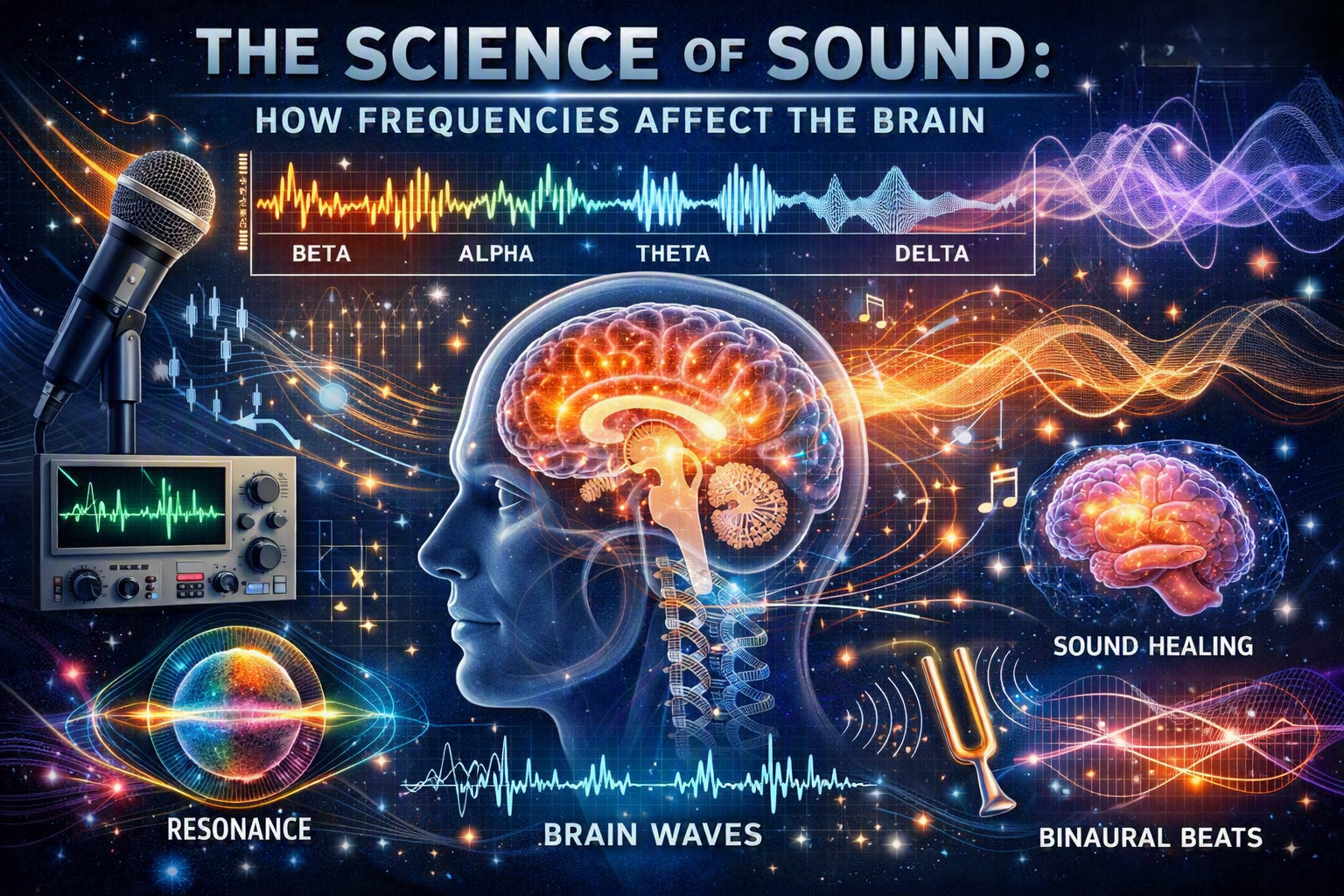
The brain naturally cycles through different electrical frequency bands, each associated with a state of consciousness:
- Beta (13–30 Hz): Active, alert, everyday thinking — often the dominant state during work or stress
- Alpha (8–13 Hz): Relaxed, calm wakefulness — the state often reported during light meditation
- Theta (4–8 Hz): Deep relaxation, drowsiness, and the edge of sleep — linked with vivid imagery and emotional processing
- Delta (0.5–4 Hz): Deep, dreamless sleep and the brain’s most restorative state
Sound healing tools — singing bowls, gongs, tuning forks, and guided sound baths — are used specifically to help guide the brain out of a Beta-dominant, “always-on” state and toward Alpha or Theta, where relaxation and stress recovery happen.
Binaural Beats vs. Isochronic Tones
Two frequencies play a large role in modern sound-based entrainment techniques:
- Binaural beats occur when two slightly different frequencies are played separately into each ear (for example, 200 Hz in one ear, 210 Hz in the other). The brain perceives a third, “phantom” frequency — in this case, 10 Hz, an Alpha frequency — and tends to synchronize toward it. This effect requires stereo headphones to work.
- Isochronic tones are a single tone pulsed on and off at a steady rate. Because they don’t rely on two-ear processing, some practitioners find them a more direct entrainment method, audible even through open speakers, as in a group sound bath setting.
The Nervous System Connection
Brainwaves are only part of the picture. Sound also talks directly to the body’s stress-response system, which is a big part of why a session can leave you feeling physically, not just mentally, different.
The Vagus Nerve and the Relaxation Response
Low, sustained tones — like those from a gong or a large singing bowl — are thought to stimulate the vagus nerve, the primary channel of the parasympathetic (“rest and digest”) nervous system. When the vagus nerve is activated, heart rate slows, breathing deepens, and the body shifts out of the sympathetic (“fight or flight”) state that chronic stress keeps switched on. This is one reason people often report a sense of heaviness or deep physical release partway through a sound bath — it’s the nervous system downshifting in real time.
Heart Rate Variability as a Marker
Heart rate variability (HRV) — the small fluctuations in time between heartbeats — is a commonly used marker of nervous system flexibility and resilience to stress. Several small studies on singing bowl meditation and gong baths have recorded measurable increases in HRV following a session, which is generally interpreted as a sign of improved parasympathetic activity and reduced physiological stress.
What the Research Actually Says
It’s worth separating what’s well-supported by research from what’s still emerging — good sound healing practice, and good SEO content, shouldn’t overstate the science.
Studies on Stress and Cortisol
Several peer-reviewed studies on sound meditation and Tibetan singing bowl practice have measured reductions in self-reported tension, anxiety, and physiological stress markers, including cortisol, after a single session. Participants in these studies also frequently report improved mood and a greater sense of wellbeing immediately afterward.
Sound and Sleep Quality
Research into binaural beats in the Delta and Theta ranges has shown promise for improving subjective sleep quality and reducing the time it takes to fall asleep, particularly when used as a consistent, pre-sleep listening practice rather than a one-off session.
Limitations of Current Research
Most sound healing studies are small in scale, and effects are often measured through self-report rather than long-term clinical outcomes. This doesn’t mean the practice is ineffective — it means sound healing is best understood as a complementary tool for relaxation and stress management, not a replacement for medical or psychological treatment. If you’re managing a diagnosed condition, sound healing works best alongside, not instead of, professional care.
Frequencies Commonly Used in Sound Healing
Not all frequencies used in sound therapy are chosen arbitrarily — many have specific traditions or acoustic reasoning behind them.
432 Hz vs. 440 Hz Tuning
Standard modern music is tuned to 440 Hz (the international pitch standard). Some sound healing practitioners instead tune instruments to 432 Hz, which they describe as sounding warmer or more “resonant” with the body, though the scientific evidence for a measurable physiological difference between the two is limited. Where it matters most in practice is subjective — many people simply report finding 432 Hz tuning more soothing to listen to.
Solfeggio Frequencies
Solfeggio frequencies are a set of specific tones (396 Hz, 417 Hz, 528 Hz, 639 Hz, 741 Hz, and 852 Hz) associated in sound healing traditions with different intentions — for example, 528 Hz is often linked to stress relief and a sense of transformation. These frequencies are widely used in guided meditations and sound bath recordings.
Singing Bowls and Gongs
Himalayan and crystal singing bowls each produce a complex blend of overtones rather than a single pure frequency, which is part of why they’re used therapeutically — the layered harmonics create a fuller entrainment effect than a single tone would. Gongs, meanwhile, produce very low, broadband frequencies that are often felt physically as well as heard, making them a common closing instrument in a full sound bath. If you’re curious what these instruments actually sound and feel like in practice, our guide to sound healing instruments breaks each one down.
Sound Frequencies and the Chakra System
In energy healing traditions, each of the body’s seven chakras is associated with a specific tone, and sound is used as a direct way to address blocked or imbalanced energy centers.
Matching Tones to Energy Centers
Practitioners commonly pair the root chakra with a low, grounding C note, moving up through the scale to the crown chakra’s higher, airier B or Om tone. The logic mirrors the physics discussed earlier — lower frequencies are felt in the lower body (grounding, security, stability), while higher frequencies resonate in the upper body and head (clarity, intuition, connection). A full chakra sound healing session typically moves sequentially through all seven tones, allowing each energy center to be addressed in turn.
Why This Pairs Well With Energy Healing
Because chakra work and sound both operate on the principle of vibrational balance, the two are often combined in a single session. At Phoenix Soul-utions, sound is frequently layered into chakra healing and chakra balancing sessions specifically for this reason — the tone provides an audible, felt anchor for work that is otherwise entirely energetic.
How This Applies to Mental and Emotional Wellness
Understanding the mechanism is useful — but the reason most people come to sound healing is for how it feels in daily life.
Reducing Anxiety and Overthinking
Because Beta-wave activity is associated with active, sometimes anxious, thinking, guiding the brain toward Alpha and Theta states through sound can create a felt sense of mental quieting — a break from rumination that many people struggle to access through willpower alone.
Supporting Meditation and Focus
Sound is also used as an anchor for meditation. Where silent meditation can be difficult for beginners to sustain, a steady tone or rhythmic instrument gives the mind something to gently return to, making the practice more accessible for people newer to mindfulness work.
Where Sound Healing Fits Alongside Energy Work
At Phoenix Soul-utions, sound is often used in combination with other modalities — including energy healing and chakra-based practices — as part of a broader approach to emotional and energetic balance, not as a standalone fix.
What to Expect in a Sound Healing Session
A typical session begins with a few minutes of settling — often lying down — followed by a sequence of instruments (bowls, gongs, chimes, or tuning forks) played in a deliberate order to guide the nervous system from alertness toward deep relaxation. Sessions usually run 45–60 minutes, and most people leave feeling noticeably lighter, calmer, or more clear-headed. If you want the full walkthrough of what a session actually involves, we’ve covered it in detail in The Benefits of a Sound Bath. And if you’re wondering whether it’s right for you medically, our piece on sound healing safety, risks, and warnings is a good next read before booking.
Bringing Sound Frequency Practices Into Daily Life
A single session can shift your state for days, but the deepest benefits tend to come from treating sound as an ongoing practice, not a one-time reset.
Simple At-Home Listening Practices
You don’t need instruments on hand to start. A 10-minute Solfeggio or binaural beat track (headphones required for binaural) during a wind-down routine, or before a focused work block, is enough to notice a difference over a couple of weeks. Pairing the audio with slow breathing — inhaling for four counts, exhaling for six — amplifies the nervous-system effect, since breath rate and vagal tone are closely linked.
Building a Simple Sound Ritual
Consistency matters more than duration. A short daily or every-other-day practice — even five to ten minutes — tends to produce more noticeable shifts in baseline stress than an occasional long session. Many people build this into an existing routine: end-of-workday listening to mark the transition out of “work mode,” or a short pre-sleep track as part of a wind-down sequence.
When to Choose a Guided Session Instead
At-home listening is a good maintenance practice, but it’s not a substitute for a full guided sound bath, where the range of instruments, live overtones, and physical vibration in the room create an effect that recorded audio through headphones can’t fully replicate. If you’re working through something specific — chronic stress, sleep disruption, or emotional processing — a guided in-person session offers a depth that’s worth experiencing at least occasionally, even if home practice fills the gaps between visits.
FAQ
1. How quickly can sound frequencies change your brainwave state?
Many people notice a shift within the first 10–15 minutes of a session, as the brain begins entraining toward the dominant frequency being played. The depth of the shift tends to build over the course of a full 45–60 minute session.
2. Do I need special headphones for sound healing to work?
Only for binaural beats specifically, since they rely on each ear receiving a different frequency. Live sound baths using singing bowls, gongs, and isochronic-style pulsing work through open-air listening, no headphones required.
3. Is there scientific proof sound healing works, or is it just relaxation?
There’s peer-reviewed evidence for measurable reductions in stress markers and improved mood after sound-based sessions, though most studies are still small-scale. It’s best understood as a well-supported relaxation and stress-management tool rather than a clinically proven treatment for specific conditions.
4. Can sound healing help with anxiety or sleep problems?
Many people use it for exactly that — the shift toward Alpha and Theta brainwave states is associated with reduced anxious thinking and better sleep onset. It works well as a consistent practice alongside, not instead of, professional mental health support when needed.
5. What’s the difference between a sound bath and sound healing generally?
A sound bath is one specific format of sound healing — a group or individual session where you’re “bathed” in layered instrument tones. Sound healing is the broader umbrella, which can also include binaural beat recordings, tuning fork work on the body, and vocal toning.
6. Does 432 Hz music actually sound different from 440 Hz to the average listener?
Most listeners can’t reliably distinguish the two in a blind comparison — the difference is roughly a quarter-tone, quite subtle to an untrained ear. What people usually respond to is the overall arrangement and instrumentation of 432 Hz recordings, which tend to be produced specifically for relaxation, rather than the tuning frequency itself.
7. Can children or older adults safely participate in sound healing sessions?
Yes, sound healing is generally considered gentle and low-risk across age groups, and many practitioners tailor session length and volume for children and older adults. As with any wellness practice, it’s worth mentioning any hearing sensitivity or medical conditions to your practitioner beforehand.
8. How is sound healing different from simply listening to relaxing music?
Relaxing music is composed for aesthetic enjoyment, while sound healing frequencies and instruments are selected specifically for their entrainment and vibrational properties — the goal is a physiological shift, not just a pleasant listening experience. That said, the line between the two is blurry, and there’s nothing wrong with relaxing music as its own form of stress relief.
Ready to Experience It Yourself?
Reading about brainwave entrainment is one thing — feeling your nervous system settle during a live session is another. If you’re in Visakhapatnam and curious what a personalized sound healing session could do for your stress, focus, or sleep, book an appointment with Phoenix Soul-utions and experience the science firsthand.