If you’ve ever sat in a sound bath and wondered what was actually making those layered, vibrating tones wash over you, the short answer is this: sound healing uses a specific family of instruments — singing bowls, tuning forks, gongs, chimes, drums, and the human voice — each producing a distinct frequency and vibration that helps the nervous system shift out of stress and into rest. No single instrument is “the best.” Practitioners often combine two or three depending on what a session is meant to address, whether that’s anxiety, sleep, focus, or emotional release.
Below, we’ll walk through each instrument, what it actually does, and how to know which one might resonate with you (pun intended).
What Is Sound Healing, Exactly?
Sound healing is a practice that uses rhythmic, resonant sound to guide the body and mind from a state of stress into a state of rest. It works largely through entrainment — the tendency of your brainwaves to sync with an external rhythm. When a slow, steady tone is sustained near you, your heart rate and breathing tend to slow to match it, nudging your nervous system out of “fight or flight” and into “rest and digest.”
The instrument matters because each one produces a different wave pattern, overtone structure, and physical sensation. Some are felt more than heard. Others are sharp and precise. Understanding the differences helps you know what to expect walking into a session — or what to look for if you’re building a home practice.
What Does the Research Actually Show?
Sound healing is still a young field scientifically, but it’s no longer purely anecdotal. A handful of peer-reviewed studies have started to measure what actually happens in the body during a session.
A 2016 observational study published in the Journal of Evidence-Based Complementary and Alternative Medicine looked at Tibetan singing bowl meditation across 62 participants and found measurable reductions in tension, anxiety, and negative mood after a single session. A separate randomized controlled trial went further, using EEG and heart rate variability (HRV) monitoring to compare Tibetan singing bowl sound against progressive muscle relaxation and a no-treatment control group; the singing bowl group showed a measurable shift toward a more relaxed brainwave state along with increased HRV, a marker generally associated with a calmer nervous system.
The proposed mechanism behind these effects is entrainment: sustained, rhythmic sound appears to help activate the parasympathetic nervous system — the “rest and digest” branch that slows heart rate, lowers blood pressure, and reduces circulating stress hormones like cortisol. Some smaller studies have also reported reduced cortisol levels following sound sessions, though sample sizes in this area of research remain modest.
It’s worth being realistic about where the science currently stands. Most existing studies are small, several are observational rather than tightly controlled, and researchers still don’t fully understand why different frequencies and instruments produce different effects. What the current evidence does support fairly consistently is that sound-based sessions can measurably shift markers of stress and relaxation in the short term — which lines up with what practitioners have long observed anecdotally, even if the full picture isn’t settled yet.
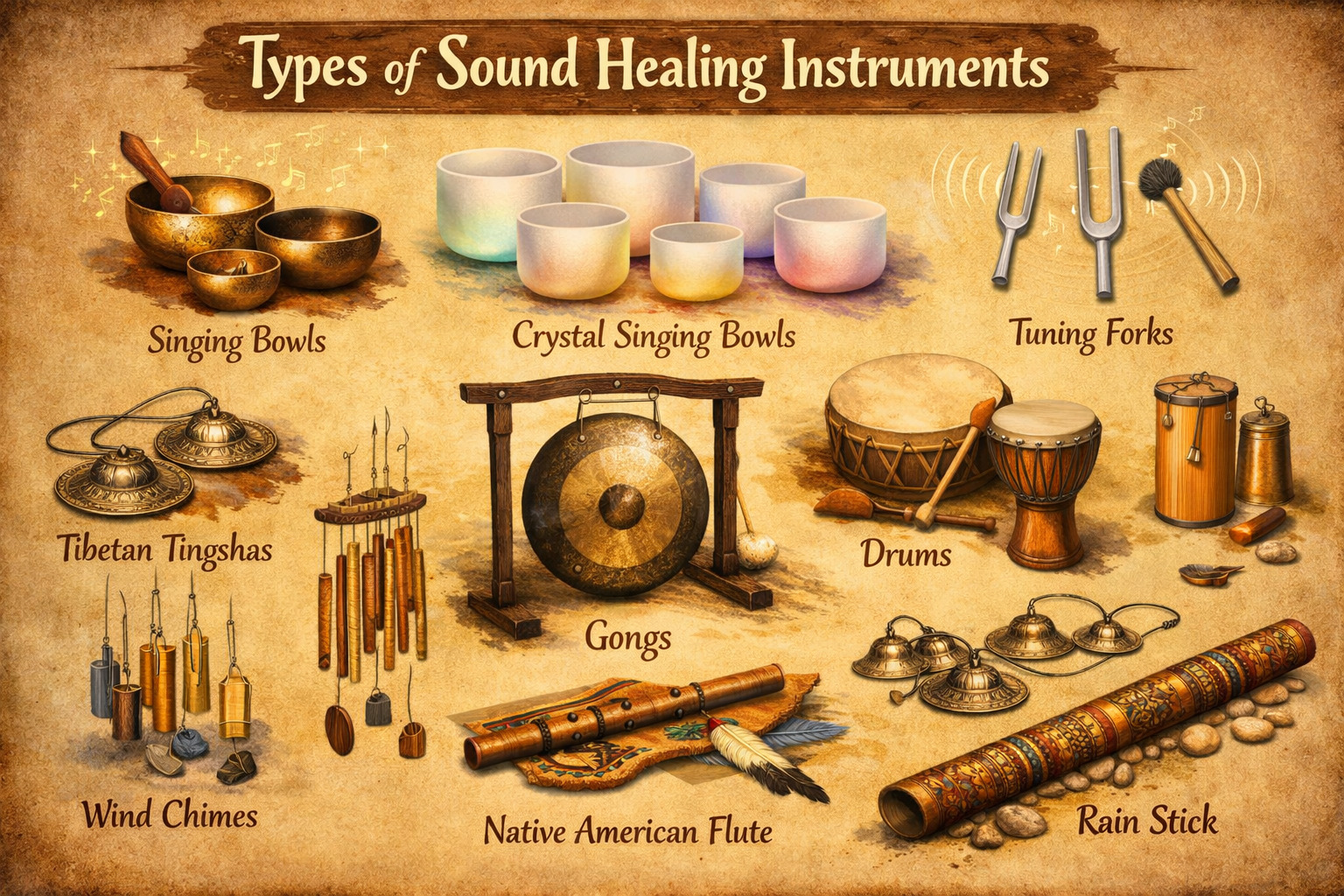
Singing Bowls
Singing bowls are probably the most recognizable sound healing instrument, and for good reason — they’re versatile, portable, and produce a sound that’s both grounding and expansive.
Tibetan Singing Bowls
Traditionally hand-hammered from a blend of metals, Tibetan bowls produce a rich, complex tone made up of several overlapping frequencies at once. Played by striking the rim or circling it with a wooden mallet (“striker”), they create a slow-building hum that many people describe as feeling like it moves through the body rather than just the ears. These bowls are commonly placed directly on or near the body during a session, so the vibration is felt as much as heard.
Crystal Singing Bowls
Made from quartz crystal, these bowls produce a purer, more singular tone than their metal counterparts — closer to a bell than a hum. Each bowl is typically tuned to a specific musical note, and in many practices, each note is associated with a particular energy centre in the body. Crystal bowls tend to have a brighter, more penetrating sound, which some people find more intense than the softer tone of a metal bowl.
Singing bowls specifically — more than most other instruments on this list — are the ones sound healing research has focused on, largely because their sustained, layered tone is easy to test in a lab setting against clear before-and-after measures like mood scores and HRV.
Tuning Forks
Tuning forks bring precision to sound healing. Unlike bowls, which produce a blend of frequencies, a tuning fork vibrates at one exact, calibrated pitch. Practitioners strike the fork and either hold it near the ears or place the base directly against the skin — often at joints, along the spine, or near specific points on the body.
Because the frequency is so exact, tuning forks are frequently used for targeted work: releasing tension in a specific muscle group, calming a busy mind before meditation, or working with specific frequency sets believed to correspond to different states of relaxation. They’re a favourite for people who want something more clinical and precise than the broader “wash” of a bowl or gong.
Direct research on tuning forks specifically is thinner than the singing bowl studies, though the same entrainment principle they’re built on — a single, stable frequency guiding the nervous system toward a matching, slower rhythm — is the same mechanism researchers point to when explaining why sustained tones affect heart rate and brainwave activity more broadly.
Gongs
If singing bowls are a gentle stream, a gong is closer to a wave. Gongs produce an enormous range of overtones and harmonics in a single strike, and a skilled player can shape that sound into rising and falling waves of intensity for 20–40 minutes at a time.
Gong baths (as full sessions are often called) are known for producing a particularly deep, almost disorienting sense of relaxation — many people describe losing track of time entirely, or feeling like the sound is coming from inside their own chest rather than from across the room. Because the sound is so full-bodied, gongs are often used toward the end of a longer session, once the nervous system is already primed to let go.
Gongs are usually studied alongside singing bowls rather than on their own, but the same 2016 sound-meditation research noted above included gong sessions in its intervention group and reported similar reductions in perceived stress and tension across the study period.
Chimes and Bells
Where gongs and bowls create sustained waves, chimes and small bells are used more like punctuation — marking the beginning or end of a phase, or gently redirecting attention.
Tingsha Cymbals
These small, paired Tibetan cymbals produce a high, clear ring when struck together. They’re often used to open or close a session, or to signal a transition — for example, moving from breathwork into the sound portion of a practice.
Koshi Chimes
Wind chimes tuned to specific elemental scales (often labelled Air, Water, Earth, and Fire), Koshi chimes produce a soft, cascading sound that’s frequently layered underneath a bowl or gong rather than used on its own. They add texture without overpowering the deeper tones happening around them.
Drums
Drums bring rhythm into a practice that’s otherwise built around sustained tones, and rhythm works on the nervous system differently — it can be energizing rather than purely calming.
Frame Drums and Shamanic Drums
A steady, repetitive drumbeat — often held around 4–7 beats per second — is associated with shifting brainwave activity toward a theta state, the same state linked to deep meditation and the edge of sleep. These drums are frequently used in journeying or trance-based sound work, where the goal is an inward, meditative focus rather than pure relaxation. Separately, early-stage animal research on vibration exposure has pointed to measurable changes in stress-related brain regions, offering a possible biological explanation for why rhythmic, low-frequency vibration affects anxiety-like states — though this line of research is still preliminary and hasn’t yet been confirmed in humans.
Handpan
A newer addition to the sound healing world, the handpan (sometimes mistaken for a “hang drum”) produces a melodic, almost otherworldly tone when tapped by hand. It blends the resonance of a singing bowl with the rhythmic quality of a drum, making it a popular choice in more contemporary sound sessions.
More Sound Healing Instruments Worth Knowing
Beyond the instruments most people picture when they think of a sound bath, a few others show up regularly in practice — each bringing something the more familiar tools don’t.
Monochord
A monochord is a wooden, table-like instrument strung with many strings all tuned to the same note (or close variations of it). Instead of sitting across the room from you, it’s typically placed directly under the body you’re lying on, so the vibration travels up through the wood and into your spine. The effect is closer to feeling a continuous hum in your bones than hearing a melody — many people find it one of the most physically grounding instruments in a session.
Rain Stick
Originally used in South American ceremonial traditions, a rain stick is a hollow tube filled with small beads or seeds that cascade past internal baffles when tilted, producing a soft, steady sound similar to falling rain. It’s rarely a centrepiece instrument on its own, but it’s often used to open or close a session, or layered quietly in the background to add a sense of natural, unhurried movement to the soundscape.
Ocean Drum
An ocean drum is a wide, shallow frame drum containing loose metal beads or ball bearings between two drumheads. Tilted gently, it mimics the rolling, rhythmic sound of waves. Because that wave-like pattern closely resembles natural breathing rhythms, it’s frequently used to guide breathwork or to ease someone into a lying-down relaxation state at the start of a session.
Didgeridoo
An Australian Aboriginal wind instrument, the didgeridoo produces a low, continuous drone through circular breathing. That sustained low frequency creates a strong, resonant vibration that many people feel in the chest and torso rather than simply hear. It’s less commonly used than bowls or gongs in most modern sound healing spaces, but where it is used, it tends to leave a distinctly deep, full-body impression.
The Human Voice as an Instrument
It’s easy to overlook, but the voice — through chanting, toning, or mantra — is one of the oldest sound healing tools there is. Sustained vowel sounds (“Om,” for instance) create vibration in the chest, throat, and skull that can be felt internally in a way instruments played across the room simply can’t replicate. Many practitioners layer voice work with instrumental sound, using chanting to open a session before bowls, gongs, or chimes take over.
How to Choose the Right Instrument (or Session) for You
There’s no universal “correct” instrument — it depends on what you’re looking to shift:
- Feeling anxious or wired: Sustained tones from Tibetan bowls or a gong bath tend to help the body slow down gradually.
- Wanting mental clarity or focus: Crystal bowls or tuning forks offer a more precise, alert kind of calm.
- Looking for deep, meditative stillness: A slow, rhythmic drum can guide you into a theta-wave state more effectively than tonal instruments alone.
- New to sound healing altogether: A group sound bath that layers several instruments is often the gentlest introduction, since you’re not relying on one single sound to “work.”
If anxiety specifically is what’s bringing you to sound healing, our guide on sound healing for anxiety breaks down what to realistically expect and how it compares to other approaches.
What Happens in a Sound Healing Session
A typical session begins with you lying down or sitting comfortably, often with a light blanket, while the practitioner moves through a sequence of instruments — perhaps opening with tingsha or voice, building through bowls or drums, and closing with a longer gong or bowl wash. You’re not required to do anything except stay still and let the sound work on the body; many people drift into a state between waking and sleeping, which is a normal and often the most restorative part of the experience.
At Phoenix Soul-utions Holistic Wellness Center in Visakhapatnam, sound work is often combined with our broader energy healing and chakra healing and balancing practices, so the instruments used in a session are chosen specifically around what you’re working through — not applied generically.
Frequently Asked Questions
1. Do I need to know anything about music to benefit from sound healing? No. Sound healing isn’t a performance or a musical experience in the traditional sense — you’re a receiver, not a participant. No musical background or “good ear” is required to feel its effects.
2. Which instrument is best for beginners? Most beginners start with a group session that uses singing bowls, since the tone is gentle, sustained, and easy to relax into without any single sharp sound catching you off guard.
3. Can sound healing instruments help with sleep? Many people use recordings or live sessions with Tibetan bowls or slow drumming before bed, as the sustained low frequencies can support the shift into a more relaxed, sleep-ready state.
4. Is sound healing a replacement for therapy or medication? No. Sound healing is a complementary practice that supports relaxation and emotional regulation — it isn’t a substitute for medical or psychological treatment, particularly for diagnosed conditions.
5. How often should I do a sound healing session? This varies by person and goal. Some people benefit from a single session before a stressful event, while others build it into a regular practice, such as weekly or biweekly, especially when working through anxiety or sleep issues.
Ready to Experience It for Yourself?
Reading about sound healing instruments only tells you so much — the shift happens when you actually feel the vibration in the room. If you’re in or around Visakhapatnam and curious about which instruments might suit what you’re going through, book a session with Phoenix Soul-utions Holistic Wellness Center or get in touch with us to ask a few questions first. You can also explore our self-healing workshops if you’d like to experience sound work alongside a wider group practice.