If you’ve been Googling this at 2 a.m. with your heart racing, here’s the honest answer: sound healing can meaningfully reduce anxiety symptoms by calming your nervous system, but it isn’t a medical replacement for prescribed medication. The two aren’t competitors — they work on different layers of the same problem. Medication manages brain chemistry; sound healing retrains how your body responds to stress in the first place. For many people, the real question isn’t “either/or” — it’s how to combine both safely, or how to use sound as a bridge toward needing less medication over time, under a doctor’s guidance.
Anxiety isn’t just a thought pattern — it’s a nervous system stuck in high alert. And that’s exactly the layer sound healing works on.
What Sound Healing Actually Is (Beyond the Singing Bowls)
Sound healing uses specific tones, vibrations, and frequencies — from Tibetan singing bowls and tuning forks to gongs and binaural beats — to shift your body out of a stressed state and into a relaxed one. It’s not about “listening to nice music.” It’s a structured practice that uses vibration to influence your autonomic nervous system, the part of you that controls fight-or-flight versus rest-and-digest.
When a bowl is struck near you, the sound waves don’t just hit your ears — they move through your body as physical vibration. Your muscles, your breath, and even your heart rate can entrain, or sync, to a slower rhythm. This is the same principle behind why a mother’s heartbeat calms a newborn, or why a slow drumbeat can lower a room’s collective heart rate during a ceremony.
Why Vibration Affects Anxiety Specifically
Anxiety often shows up as a body problem before it’s a thought problem — shallow breathing, a tight chest, a racing pulse, a mind that won’t stop scanning for danger. Sound healing works because it bypasses the overthinking mind and speaks directly to the body. You don’t have to “think your way calm.” The vibration does the regulating for you, which is precisely why people who’ve tried talk therapy or willpower alone often find sound healing brings relief where other approaches felt exhausting.
The Frequencies People Talk About
You’ll often see numbers like 432 Hz, 528 Hz, or the Solfeggio frequencies mentioned online, sometimes with big claims attached. Here’s the grounded version: certain frequencies, particularly in the lower ranges produced by singing bowls and gongs, are associated with slower, deeper breathing and increased alpha and theta brainwave activity — the same brainwave states linked to meditation and deep relaxation. The exact number matters less than the consistency of the practice and the quality of the session.
What the Research Says (Without the Hype)
It’s worth being honest here, because overpromising helps no one. Peer-reviewed research on sound healing for anxiety is still growing, but existing studies on singing bowl meditation and Tibetan sound baths have shown measurable reductions in tension, anger, and fatigue, along with improvements in reported well-being after a single session. Other research on binaural beats has linked certain frequency patterns to reduced state anxiety, particularly in clinical and pre-procedure settings.
What this research does not say is that sound healing cures anxiety disorders or should replace prescribed treatment for diagnosed conditions like Generalized Anxiety Disorder or Panic Disorder. What it does show is that sound-based practices reliably shift the nervous system toward a parasympathetic, “rest and digest” state — which is the same physiological target that many anxiety treatments are aiming for, just reached through a different door.
So, Can Sound Healing Replace Stress Medication?
This deserves a direct, non-generic answer.
If your anxiety is mild to moderate, situational, or stress-related — deadlines, life transitions, general overwhelm — sound healing combined with breathwork and lifestyle changes can genuinely reduce your reliance on daily coping tools, and for some people, be the primary tool that works.
If you’re on prescribed medication for a diagnosed anxiety disorder, sound healing should be viewed as a powerful complement, not a replacement. Never stop or reduce medication without your prescribing doctor’s guidance. What sound healing can do in this case is lower your baseline stress load, improve sleep, and give your nervous system practice at returning to calm — which often makes daily life feel more manageable alongside your existing treatment.
The honest goal isn’t “pills versus bowls.” It’s building a nervous system that has more than one way back to calm.
What Actually Happens in a Sound Healing Session
If you’ve never experienced one, the unfamiliarity itself can feel stressful — so here’s what to expect, step by step.
Before the Session
You’ll usually lie down comfortably, fully clothed, often with a blanket and eye pillow. There’s no physical manipulation involved — sound healing is passive; you simply receive.
During the Session
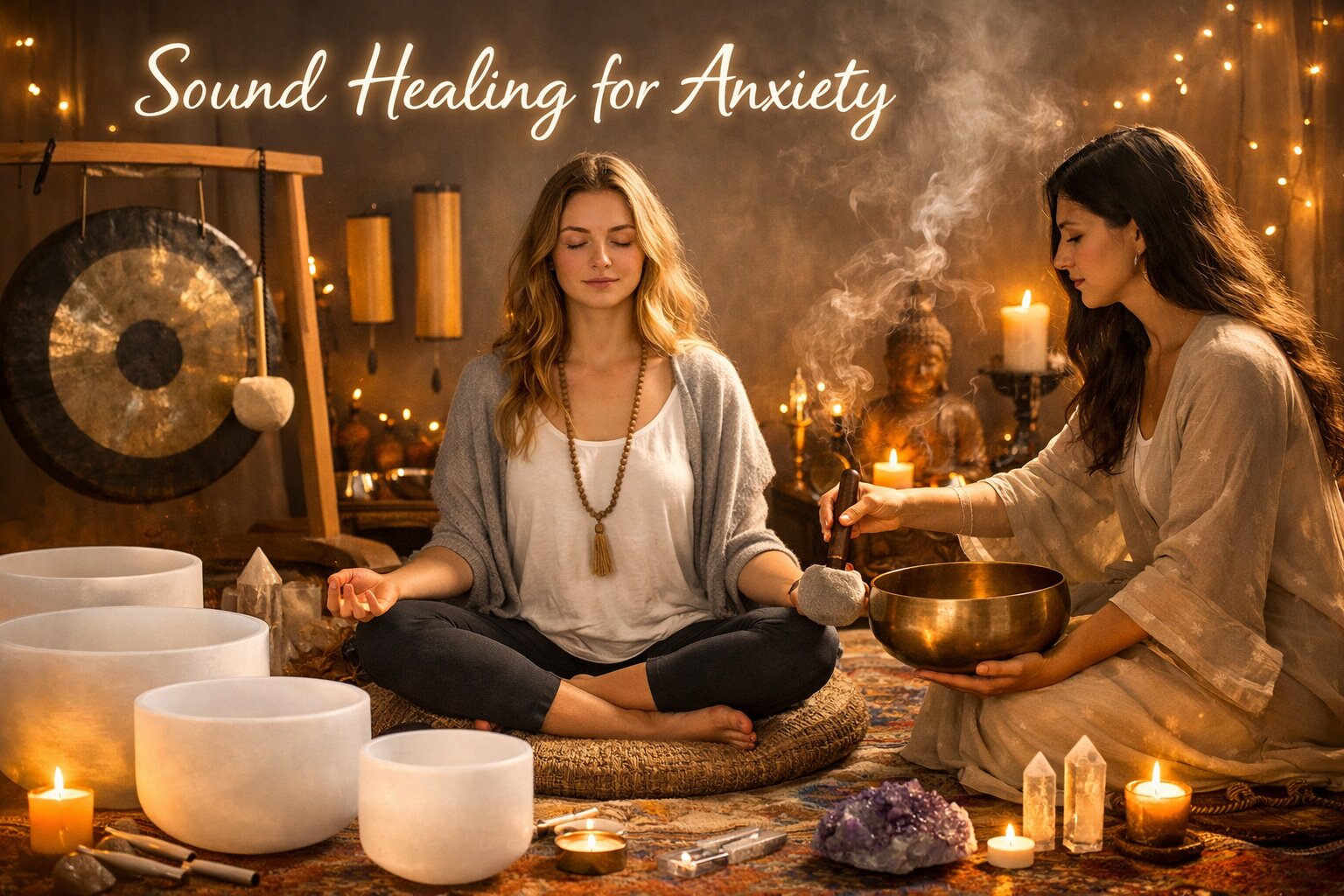
The practitioner plays a sequence of instruments — often Tibetan or crystal singing bowls, tuning forks placed near (not on) the body, chimes, and sometimes a gong — moving through different tones and rhythms. Many people report a state between waking and sleeping, sometimes emotional release like unexpected tears, and often a deep sense of heaviness or floating. This is a normal sign of nervous system release, not something to be alarmed by.
After the Session
Most people feel calm, sometimes tired, occasionally emotionally raw for a few hours — which is why it’s worth scheduling sessions on days without immediate high-pressure demands afterward. Drinking water and resting rather than rushing back into stimulation helps the effects settle in.
Building Sound Healing Into an Anxiety Management Routine
A single session can bring noticeable relief, but anxiety management works best as a rhythm, not a one-time fix.
Weekly or Biweekly Sessions
Consistency trains the nervous system the way consistency trains a muscle. Regular sessions build a stronger, faster return-to-calm response over time, rather than only offering temporary relief.
Pairing Sound Healing With Breathwork
Slow, extended-exhale breathing activates the vagus nerve, the same pathway sound vibration influences. Combining the two amplifies the calming effect and gives you a portable tool you can use outside of sessions.
Combining With Other Holistic Support
Anxiety rarely has one cause, so it rarely responds to one solution. Many people find the strongest, most lasting results when sound healing is paired with structured stress management support and practices that work directly with the body’s energy centers, such as chakra healing and balancing.
Who Should Be Cautious With Sound Healing
Sound healing is gentle, but it isn’t universally risk-free. People with severe misophonia, certain seizure conditions, or during early pregnancy should consult a doctor before intense vibrational or gong-based sessions. Anyone with a diagnosed anxiety or mood disorder should treat sound healing as a complementary support, discussed openly with their psychiatrist or therapist, not a substitute for their treatment plan.
The Instruments, and What Each One Actually Does for Anxiety
Not all sound healing instruments work the same way, and knowing the difference helps you understand what you’re actually paying for and why a good session uses more than one.
Tibetan and Himalayan Singing Bowls
Made from a mix of metals, these produce a rich, layered tone with multiple overtones at once. That layered quality is what makes them so effective for anxiety — the brain can’t easily “predict” a single note, so it lets go of its usual vigilance and settles instead of tracking the sound analytically.
Crystal Singing Bowls
Made of quartz, these produce a single, pure, sustained tone. Different bowl sizes correspond to different chakra points, and practitioners often use them to target specific areas of tension, such as a bowl tuned to the heart center for grief-related anxiety, or the throat for anxiety tied to suppressed expression.
Tuning Forks
Weighted tuning forks are placed near or lightly on specific points of the body, delivering a precise, localized vibration. They’re often used for targeted tension release — a tight jaw, a clenched chest, a knotted stomach — rather than the full-body wash of a bowl or gong.
The Gong
The most intense of the instruments, a gong produces a complex wall of overtones that can feel overwhelming at first and deeply cathartic by the end. Gongs are typically introduced only once a person is used to sound healing, since the initial intensity can momentarily spike anxiety before it drops.
Chimes and Rattles
Lighter and higher-pitched, these are often used at the start or end of a session to gently bring the nervous system in and out of the deeper states reached with bowls and gongs, avoiding an abrupt transition back to alertness.
Sound Healing vs. Other Anxiety Approaches: How They Actually Compare
It helps to see where sound healing fits next to the tools you may have already tried.
Sound healing vs. medication: Medication works at the biochemical level, adjusting neurotransmitters like serotonin and GABA. Sound healing works at the nervous system and vibrational level, shifting you out of fight-or-flight through the body rather than the bloodstream. They address anxiety from different directions, which is exactly why they can be used together rather than as substitutes.
Sound healing vs. talk therapy: Therapy works with the thinking mind — identifying patterns, reframing beliefs, processing the “why” behind anxiety. Sound healing works with the body first, often making people more receptive to therapy afterward because the nervous system isn’t as defensively activated.
Sound healing vs. meditation: Meditation asks you to actively direct attention, which can be genuinely difficult for an anxious mind that resists stillness. Sound healing is receptive rather than effortful — the vibration does the work of quieting the mind for you, which is why many self-described “bad meditators” respond well to it.
Sound healing vs. yoga or breathwork: These are active, body-based practices you perform yourself. Sound healing is something you receive while lying still, making it a good option on days when anxiety leaves you too depleted to actively “do” a practice.
A Real Scenario: What Change Often Looks Like
Anxiety rarely disappears in one dramatic moment — it tends to loosen gradually, and it helps to know what that actually looks like so you’re not expecting an overnight cure.
A first-time client typically arrives with a racing mind, shallow breathing, and difficulty settling even lying down. During the first session, it’s common to feel restless for the first ten minutes before the body starts to trust the process and breathing deepens. By the second or third session, many people report falling into a genuinely restful state partway through, sometimes with spontaneous emotional release. By the fourth to sixth session, the shift tends to move beyond the session itself — people notice they catch their own anxiety spiraling earlier in daily life, and find it easier to bring themselves back to calm without needing a full session to do it. That carry-over into daily life, more than the in-session relaxation itself, is the real marker that the nervous system is retraining.
How to Choose a Sound Healing Practitioner
Not all sound healing is equal, and for anxiety specifically, the practitioner’s training matters as much as the instruments.
Look for trauma-awareness. Anxiety and past trauma are often linked, and a practitioner trained to recognize signs of a nervous system becoming overwhelmed — not just relaxed — can adjust the session accordingly rather than pushing through it.
Ask about session structure. A well-structured session builds intensity gradually and brings you back down gently at the end, rather than ending abruptly on a high-intensity instrument like the gong.
Check whether they integrate other modalities. Anxiety is rarely purely physical or purely energetic. Practitioners who can also speak to stress patterns, energy blocks, or chakra imbalance tend to offer more complete support than a purely instrumental session.
Ask what happens if you get emotional. Crying, shaking, or unexpected emotion during a session is common and healthy. A good practitioner will have a calm, prepared response rather than treating it as something to rush past.
Frequently Asked Questions
1. How many sound healing sessions does it take to feel a difference?
Many people notice calmer breathing and reduced tension after just one session, but lasting shifts in baseline anxiety typically build over four to six regular sessions, similar to how any nervous system retraining takes repetition.
2. Is sound healing backed by science, or is it just relaxation with extra steps?
There’s a real physiological mechanism at play — vibration influences heart rate variability, brainwave states, and the vagus nerve, all measurable markers linked to the body’s stress response. It’s not the same evidence base as pharmaceutical trials, but it’s more than “just relaxation.”
3. Can I do sound healing for anxiety at home with YouTube videos?
Recorded audio can help with general relaxation, but it doesn’t replicate the physical vibration that a live session, felt through the body via instruments in the room, produces. Recordings are a good daily supplement, not a full substitute for in-person sessions.
4. Is it safe to stop my anxiety medication once I start sound healing?
No — medication decisions should only be made with your prescribing doctor. Sound healing works well alongside medical treatment; any change to medication should be a medical decision, not a wellness one.
5. What’s the difference between sound healing and meditation for anxiety?
Meditation is an active mental practice requiring focus and effort, which can actually feel harder for an anxious mind. Sound healing is receptive — you don’t have to “do” anything correctly, which is often why people who “can’t meditate” still find sound healing accessible and effective.
6. Will I fall asleep during a sound healing session, and is that a problem?
It’s common, and it’s not a problem at all. Falling asleep usually means your nervous system trusted the space enough to fully let go, which is often exactly what a chronically anxious body needs.
7. Is sound healing safe for teenagers or people who are new to any kind of therapy?
Yes, and it’s often an easier entry point than talk therapy for people who feel intimidated by “talking about their feelings.” Because it’s passive and doesn’t require verbal processing, it can be a gentle first step toward broader emotional support, ideally alongside a parent or guardian’s involvement for younger teens.
Ready to Feel Calmer, Not Just Cope?
If anxiety has been running your days and you’re looking for a real, felt sense of relief — not just another technique to add to your to-do list — a guided sound healing session can be the reset your nervous system has been asking for. At Phoenix Soul-utions Holistic Wellness Center, our sessions combine sound, energy work, and structured stress management so you leave with more than a moment of calm — you leave with a tool you can return to.
Book your session now or explore our self-healing workshops to build a fuller anxiety support routine.