If you’ve been exploring holistic wellness, chances are you’ve come across both Pranic Healing and Reiki. Both are powerful energy-based healing systems that work with the body’s life force energy to restore balance, reduce stress, and support physical and emotional wellbeing. But which one is better?
The honest answer: neither is universally “better.” Each serves a unique purpose, and the right choice depends on your personal goals, sensitivity to energy, and the nature of the healing you seek. This guide breaks down exactly how each system works, where they differ, and how to choose — so you can make a confident, informed decision.
What Is Pranic Healing?
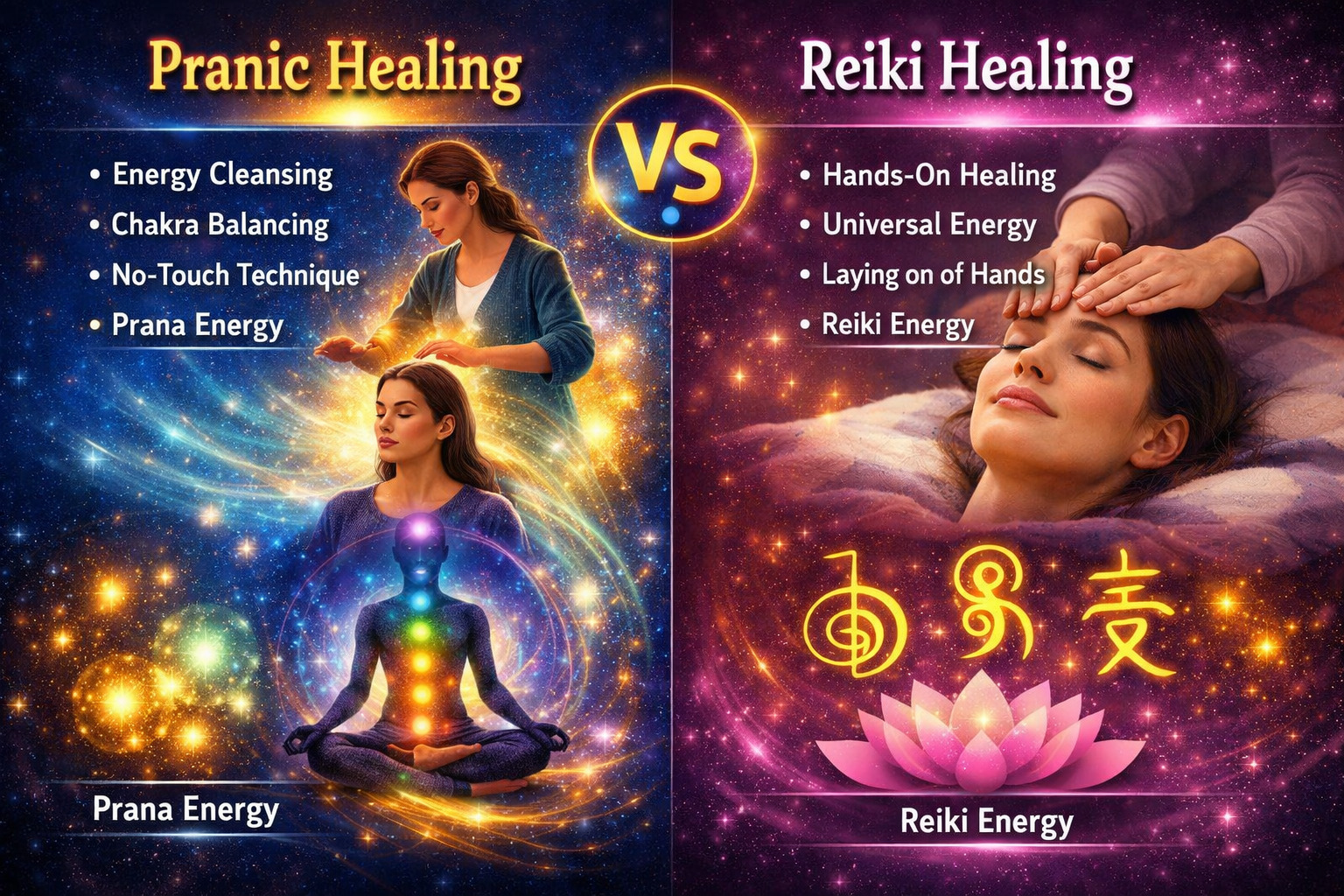
Pranic Healing is a no-touch energy healing system developed by Grand Master Choa Kok Sui in the 1980s. It operates on the principle that the human body has an energy field (called the aura) and energy centres (called chakras). When this energy field is depleted or congested, physical and emotional ailments arise.
How Pranic Healing Works
Pranic Healing follows a structured, two-step protocol:
- Cleansing — The practitioner first removes diseased or stagnant energy (called “used” or “dirty” prana) from the affected area of the aura or chakra.
- Energising — Fresh, revitalised prana is then projected into the cleansed area to accelerate the body’s natural healing response.
This method is highly systematic. Pranic Healers are trained to follow specific protocols for different conditions — from physical ailments like headaches, joint pain, and respiratory issues, to emotional challenges like anxiety, depression, relationship problems, and trauma.
Key Characteristics of Pranic Healing
- No physical touch — The practitioner works entirely within the energy body, typically 6–12 inches away from the physical body.
- Protocol-based — There are specific step-by-step procedures for hundreds of conditions.
- Uses prana from multiple sources — Ground prana, air prana, solar prana, and divine energy.
- Measurable — Aura scanning is a diagnostic tool used by practitioners to identify energy imbalances before and after treatment.
- Distance healing is fully supported — Sessions can be conducted remotely with equal effectiveness.
Origins and Philosophy
Grand Master Choa Kok Sui synthesised Pranic Healing from ancient healing traditions — including Chinese, Indian, and Tibetan energy medicine — and validated it through extensive scientific research and experimentation. The system emphasises that prana (life force) is the “sole factor” that accelerates healing, and that the body knows how to heal itself when supplied with sufficient clean prana.
What Is Reiki?
Reiki is a Japanese energy healing technique developed by Mikao Usui in the early 20th century. The word “Reiki” translates to “Universal Life Energy.” It is based on the principle that a practitioner can channel universal energy through their hands to a recipient, activating the natural healing processes of the body and restoring physical and emotional wellbeing.
How Reiki Works
A Reiki practitioner acts as a channel for universal energy. During a session, they place their hands lightly on or just above specific areas of the body — corresponding to chakras or areas of concern — and allow energy to flow through them to the recipient. The energy is guided by the recipient’s Higher Self, meaning it naturally goes where it is most needed.
Unlike Pranic Healing, Reiki does not involve active removal of negative energy. Instead, the practitioner simply opens themselves as a conduit and allows universal energy to flow in. The intelligence of the universal energy does the rest.
Key Characteristics of Reiki
- Gentle hands-on or near-body technique — Practitioners use light touch or hovering hands.
- Intuitive, not protocol-based — Energy flows where it’s needed without the practitioner directing it to a specific organ or chakra.
- Passive approach — Practitioners do not actively cleanse or energise; they simply allow.
- Attunement-based — Reiki practitioners must receive formal attunements from a Reiki Master to be able to channel energy.
- Five core principles (Reiki Precepts) — Including “Just for today, I will not anger,” and “Just for today, I will be grateful.”
- Distance healing is possible — Especially with Level 2 attunement and the use of specific symbols.
Origins and Philosophy
Mikao Usui developed Reiki after a mystical experience on Mount Kurama in Japan. He taught that universal energy is infinitely available and that all human beings have the capacity to heal themselves and others when they align with this universal force. Reiki has a deeply spiritual dimension and is often accompanied by meditation, prayer, and mindfulness practice.
Pranic Healing vs Reiki: Key Differences
| Feature | Pranic Healing | Reiki |
|---|---|---|
| Origin | Philippines (Grand Master Choa Kok Sui) | Japan (Mikao Usui) |
| Touch | No touch | Light touch or near-body |
| Approach | Active — cleanse then energise | Passive — channel universal energy |
| Protocol | Highly structured and protocol-driven | Intuitive and free-flowing |
| Aura Scanning | Yes — diagnostic scanning is used | Not typically used |
| Attunement Required | No — can be learned without attunement | Yes — attunement is essential |
| Distance Healing | Yes, clearly defined protocol | Yes, especially from Level 2 |
| Focus | Specific conditions and chakras | Overall balance and wellbeing |
| Learning Curve | Steeper — requires study of protocols | Gentler — attuned relatively quickly |
| Session Duration | Typically 30–60 minutes | Typically 45–90 minutes |
Is Pranic Healing Better Than Reiki? The Real Answer
This is the question everyone asks — and it deserves a nuanced answer.
Choose Pranic Healing If:
You want targeted, condition-specific healing. Pranic Healing has detailed protocols for hundreds of physical and psychological conditions. Whether it’s chronic back pain, anxiety, liver disorders, or grief, there’s a mapped approach for it. This makes it especially effective when you have a clear issue you want to address.
You prefer a structured, learnable system. Pranic Healing can be taught systematically. If you’re someone who likes to understand the “why” and “how” behind a process, you’ll appreciate its scientific, step-by-step methodology.
You or your practitioner prefer no physical contact. Since Pranic Healing is entirely non-touch, it can feel safer, especially for individuals who are sensitive to physical contact or are healing from trauma.
You want faster or more intensive results. Because Pranic Healing actively cleanses stagnant energy before replenishing it, many practitioners and clients report more immediate or noticeable shifts — particularly for acute conditions.
You want to learn energy healing for yourself. Pranic Healing’s structured nature makes it highly teachable as a self-care system. Practitioners often teach clients basic techniques to use between sessions.
Choose Reiki If:
You’re looking for deep relaxation and emotional nurturing. Reiki sessions have a distinctly gentle, soothing quality. The experience is often described as profoundly peaceful — ideal for stress relief, burnout recovery, and emotional support.
You want a spiritually integrative experience. Reiki is deeply connected to spiritual principles and personal growth. For those on a conscious spiritual path, Reiki often resonates as a complementary practice.
You prefer a soft, intuitive approach. Reiki doesn’t follow rigid protocols. This can be liberating for both practitioners and recipients who value flow and presence over structure.
You are dealing with general fatigue, anxiety, or disconnection. Reiki is wonderful for supporting the nervous system, grounding energy, and creating a sense of wholeness — without targeting any single condition.
You want to become a practitioner relatively quickly. Reiki attunements can be received in a weekend workshop, and many people go on to use Reiki for self-care immediately after their Level 1 training.
Are Pranic Healing and Reiki Compatible?
Absolutely. Many energy healers — including practitioners at holistic wellness centres — integrate both systems into their practice. They are not mutually exclusive. In fact, combining them can be deeply powerful:
- Pranic Healing can address specific, congested energy patterns in the aura and chakras.
- Reiki can then infuse the cleared field with gentle universal energy and spiritual resonance.
Think of Pranic Healing as the detailed surgeon and Reiki as the nurturing nurse — both essential, each playing a different role in complete recovery.
Benefits of Energy Healing (Both Pranic Healing and Reiki)
Both modalities, when practised by a skilled healer, offer the following benefits:
Physical Wellbeing
- Reduced pain and inflammation
- Improved sleep quality
- Faster recovery from illness, surgery, or injury
- Support for chronic conditions (not a replacement for medical care)
- Increased vitality and immune resilience
Emotional and Psychological Wellbeing
- Relief from anxiety and panic attacks
- Support for depression and grief
- Trauma processing and emotional release
- Improved emotional regulation and resilience
- Greater sense of inner peace and calm
Mental Clarity and Focus
- Reduced mental fog and overthinking
- Enhanced concentration and productivity
- Clarity in decision-making and life direction
Spiritual Growth
- Deeper connection to intuition
- Expanded awareness of one’s energy field
- Enhanced meditation experiences
- Alignment with life purpose
Common Misconceptions About Energy Healing
“Energy healing is just placebo.”
Research on biofield therapies, including studies published in peer-reviewed journals, indicates that energy healing influences physiological markers like heart rate variability, cortisol levels, and wound healing rates. While the precise mechanism is still being studied, the effects go beyond what can be attributed to placebo alone.
“You need to believe in it for it to work.”
Energy healing works on animals, plants, and infants — none of whom carry intellectual belief systems. This strongly suggests the mechanism is not belief-dependent, though receptivity and openness can certainly enhance results.
“Energy healing replaces medical treatment.”
Responsible practitioners never position energy healing as a substitute for medical diagnosis or treatment. It is complementary — supporting the body’s natural healing alongside conventional medicine.
“Only spiritual people can benefit.”
Energy healing is for anyone — religious, secular, sceptical, or spiritually curious. Your energy field exists regardless of your beliefs.
What to Expect in a Session at Phoenix Soul-utions
At Phoenix Soul-utions Holistic Wellness Center in Visakhapatnam, energy healing sessions are personalised, compassionate, and held in a safe, confidential environment.
Whether you choose a Chakra Healing and Balancing session, Crystal Healing, Relationship Healing, or a more specialised energy treatment for Business Growth and Prosperity, here’s what a typical session looks like:
Before the Session
You’ll be invited to share what you’re experiencing — physical, emotional, or life challenges — so the healer can understand your current state and intention for the session.
During the Session
You remain fully clothed and can sit or lie down in a relaxed position. The healer will work with your energy field, scanning, cleansing, and channelling healing energy as appropriate to your needs. Sessions typically last 45–60 minutes.
After the Session
Many clients report feeling lighter, calmer, and more centred immediately after a session. You may be guided through some simple self-care practices — like breathing exercises, hydration, and grounding techniques — to integrate the healing.
H2: How to Choose the Right Healing Modality for You
Still unsure which path is right for you? Here’s a simple decision guide:
Step 1 — Identify your primary need.
- Specific physical or emotional condition → lean toward Pranic Healing
- General stress, burnout, or spiritual support → lean toward Reiki
Step 2 — Consider your preferred experience.
- Structured, logical, targeted → Pranic Healing
- Flowing, intuitive, contemplative → Reiki
Step 3 — Think about your long-term goals.
- Want to learn it yourself? → Pranic Healing has a clear curriculum; Reiki offers quick attunements
- Want regular maintenance sessions? → Both are excellent for ongoing support
Step 4 — Talk to a practitioner. The best guidance comes from a skilled, experienced healer who can assess your aura, understand your history, and recommend the most aligned approach for where you are right now.
FAQ
1. Is Pranic Healing more powerful than Reiki?
Not necessarily “more powerful” — but Pranic Healing is more targeted and interventionist. It actively removes diseased energy and replenishes prana in specific organs or chakras. Reiki allows universal energy to flow freely and intelligently. Both can be deeply transformative; the difference is in the approach, not the ceiling of healing possible.
2. Can I receive both Pranic Healing and Reiki from the same practitioner?
Yes, many holistic healers are trained in multiple energy modalities and integrate them based on your needs. At Phoenix Soul-utions, sessions are tailored to what serves you most in that moment.
3. How many sessions will I need?
This varies significantly depending on the nature and duration of the issue. Acute conditions may respond in 1–3 sessions. Chronic or deeply ingrained patterns may benefit from ongoing monthly support. Your practitioner will give you an honest assessment after your initial session.
4. Is energy healing safe?
Yes. Both Pranic Healing and Reiki are non-invasive and gentle. They have no known harmful side effects when practised by a trained and ethical healer. Some people experience a brief “healing crisis” — temporary intensification of symptoms — as the body detoxifies and recalibrates, which is considered a normal part of deep healing.
5. Can energy healing help with mental health conditions?
Energy healing is a powerful complementary support for conditions like anxiety, depression, PTSD, and emotional trauma. It works beautifully alongside conventional therapy, counselling, and psychiatric care — and is not a replacement for professional mental health treatment. At Phoenix Soul-utions, we offer integrated support that combines energy healing with psychological counselling for a whole-person approach.
Your Next Step Toward Healing
Both Pranic Healing and Reiki are remarkable, time-tested systems that have transformed thousands of lives. The question isn’t really which is “better” — it’s which one is better for you, right now, at this stage of your healing journey.
At Phoenix Soul-utions Holistic Wellness Center in Visakhapatnam, healer and psychotherapist Purrna Kraleti brings over 12 years of experience in energy healing, Yoga Prana Vidya (YPV), chakra balancing, and holistic wellness. Sessions are offered in-person at Waltair Uplands, Visakhapatnam, and virtually for those seeking distance healing.
Whether you’re healing from emotional pain, seeking relief from physical discomfort, looking to grow spiritually, or simply curious about energy — there is a space for you here.
Ready to begin?
📞 Call: +91 9855 574 449 📧 Email: soulspavizag@gmail.com 🌐 Book Online: purrnakraleti.in/book-appointment